The permit is the control. Not the paperwork about the control.
Seven types — hot work, confined space, work at height, electrical and the rest — issued with a real window, proved with a real gas test, and expired by the system rather than by somebody remembering.
Ask your site one question: how do you know that permit is still valid?
The permit in the plastic wallet by the manway was issued at 06:30. It is now 15:40. The gas test on it was taken before the crew went to lunch. The certificate that qualified the contractor to be in there expired on Tuesday.
Every one of those facts is knowable. On a paper system none of them is known, because knowing requires somebody to walk to the job and check — and the whole reason the permit exists is that nobody can be everywhere.
Which is also the real failure mode. Not an empty permit book: a permit that exists, looks complete, and was never really a decision — signed in advance because the crew was waiting, signed by the person about to do the work, or signed against a location that is not the one the job is in.
A permit system that cannot answer “is this still valid, right now” is a filing system with a safety-coloured cover.
And a permit does not make the work safe. The isolation does. The gas test does. The permit records that somebody competent decided which of those were needed — before the work, rather than reconstructed after the incident.
Sump S-2. Two people, one atmosphere, three readings.
Permit #26 — patch failed lining in effluent sump s-2. The sump was pumped down and the line isolated. Hydrogen sulphide is the hazard of record.
- 05:45
- O₂
- 18.4 %
- H₂S
- 22 ppm
- Oxygen 18.4% is below the 19.5% minimum.
- Hydrogen sulphide 22 ppm is above the 10 ppm limit.
Pre-entry test, taken at the manway on the way past. The sump had not been ventilated for long enough. Tested by Anthony Russo.
- 06:30
- O₂
- 20.6 %
- H₂S
- 8 ppm
After a further 45 minutes of forced ventilation. Entry proceeds. Tested by Anthony Russo.
- 09:00
- O₂
- 20.5 %
- H₂S
- 6 ppm
Two-and-a-half-hour re-test, taken with the entrant at the base. Tested by Tanya Brooks.
- Three readings against permit #26, each with the time it was taken and the name of the person who took it. The refusal stays on the record permanently — it is the most valuable line in the file, because it is the one that shows the system worked. Illustrative data — not a customer.
The first test happened at the manway, on the way past, before anybody opened the cover — and it said no, in words, on the phone. Not a red square. Two sentences naming which limit was breached and by how much.
A reading nothing compares to a limit is not a control
A number on a meter is data. A number judged against your entry procedure, in words, at the hole, is a decision.
| Gas | Entry limit | Why |
|---|---|---|
| Oxygen (O₂) | 19.5 – 23.5 % | Below 19.5% impairs judgement before it impairs breathing — people do not notice it happening. Above 23.5% is enriched, which reads like plenty of air and means clothing and oil ignite readily. |
| Flammables | under 10 % LEL | Ten per cent of the lower explosive limit, not ten per cent gas. The distinction is the whole reading, and confusing the two is a factor of several hundred. |
| Hydrogen sulphide (H₂S) | under 10 ppm | Deadens the sense of smell as concentration rises — you stop smelling it exactly when it starts mattering, so a nose is not a monitor. |
| Carbon monoxide (CO) | under 25 ppm | Usually somebody else’s engine or a compressor intake, which is why it turns up in spaces nobody expected it in. |
23.6% is not “plenty of air”
Oxygen enrichment is the one people get wrong, because the number looks generous. An enriched atmosphere means clothing, hair and oily rags ignite readily and burn fast. A high oxygen reading is a reason to stop, not a reason to relax.
Your procedure outranks ours
These are configurable defaults, per site. The verdict is frozen against the limits that applied at the moment of entry, so tightening or loosening a limit later never silently re-scores a reading somebody already acted on. And a permit with no oxygen reading fails outright — an atmospheric test without oxygen is not a test.
All three are already on this site
Not hypotheticals. Each of these is a record on another page here, and each one turns on a permit.
The permit that was never raised
The site treats thermography as a non-contact inspection and issues no energized-work permit for it, so the approach boundary and the PPE category were never assessed for the task. Nobody skipped a step — the task was classified as something that does not need a permit, and the classification was wrong.
Investigation #5 · Arc flash during panel inspectionThe permit that was raised and wrong
A contractor refused to start hot work because the permit described a different location, and asked for it to be reissued.
Observation #25 · Contractor challenged a permit that did not match the workThe permit issued to somebody unqualified
An open corrective action on the board right now: verify contractor certification before any permit is issued to a third party. The permit was valid. The competence behind it had never been checked.
Action #58 · owned by Karen LiuThe first one is the one worth sitting with. Nobody skipped a step — the task was classified as work that does not need a permit, and the classification was wrong. No permit system catches that. What it can do is make the classification a decision somebody signed rather than an assumption nobody wrote down.
Four kinds, four different questions
Permit types are templates an administrator builds — these are the ones this site already references, each with the record that references it.
Hot work
Whether cutting, welding or grinding may happen in this area today, with what gas test, what watch and what stand-down time afterwards.
The brochure's worked example: hot work in bay 4, approved in minutes.
Confined space entry
Whether this space may be entered, on what atmosphere reading, with an attendant posted and a rescue plan that does not depend on the fire service arriving.
The confined-space capture template on /investigations asks whether the entry permit was valid — because that is the first question after an entry goes wrong.
Energized electrical work
Whether a panel may be worked live at all, and if so at what approach boundary and in what arc-rated PPE category.
Investigation #5 on /investigations: the root cause is that this site issues no energized-work permit for thermography, so the boundary and the PPE category were never assessed.
Site access
Which company, which people, which areas and which week — the permit a contractor is working under before they are working under any other one.
The contractor scenario: registration raises the site-access permit, and the geofence enforces its boundary rather than the gatehouse log.
The tell is that other modules ask about them
A product with a permits module has a permits module. A product with permits has them turn up as questions on forms that are not about permits — because when an entry or a live-panel job goes wrong, the permit is the first thing anybody asks about. These are capture fields on the investigation templates:
Confined Space
Entry permit valid?
Electrical / Arc Flash
Energized work, with or without a permit
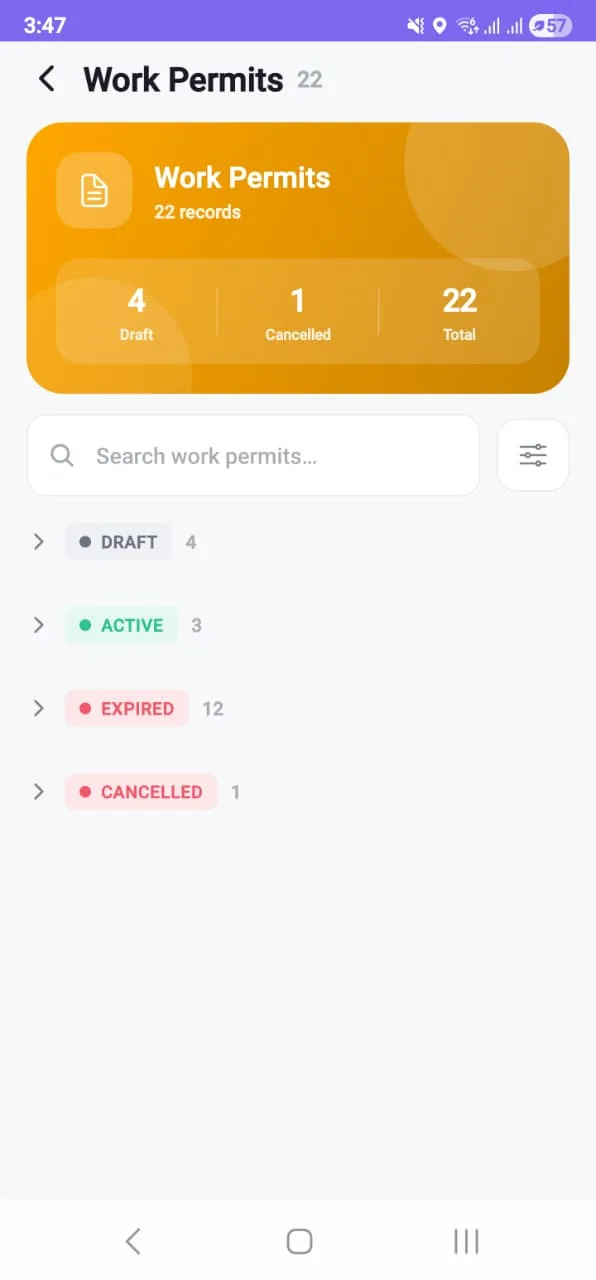
22 permits, three of them live right now
Every permit, every state, filterable by type. The question a paper system cannot answer from where you are sitting is the first thing this one shows you.
Permit register
One working month, every state a permit can be in
| Permit | Type | Work | Location | Window | Issuer | Receiver |
|---|---|---|---|---|---|---|
| #24 | ChemicalActive | Decant caustic from the bulk IBC to day tanks | Baton Rouge — Drum Storage | Aug 11 | Derek Coleman | Marcus Delgado |
| #26 | Confined spaceActive | Patch failed lining in effluent sump S-2 | Houston — Chemical Yard | Aug 11 | Anthony Russo | Tanya Brooks |
| #27 | Work at heightActive | Replace mezzanine edge protection at the loading gate | Houston — Warehouse A | Aug 11 | Anthony Russo | Northline Access Ltd |
| #29 | Hot workAwaiting signature | Cut and weld the new swarf tray bracket, weld bay 2 | Gary — Weld Bay 2 | Aug 12 | Derek Coleman | James Okonkwo |
| #30 | ExcavationAwaiting signature | Break out and re-lay the yard drain run | Houston — Loading Dock 3 | Aug 13 – Aug 14 | Anthony Russo | Marcus Delgado |
| #31 | ElectricalDraft | Thermographic survey of the main switchroom panels | Ridgeline Houston Plant | Aug 14 | Derek Coleman | Priya Natarajan |
| #32 | Hot workDraft | Braze the coolant line at the press line | Ridgeline Houston Plant | Aug 14 | Derek Coleman | Victor Ramos |
| #28 | Hot workCancelled | Grind and dress the loading dock kerb repairs | Houston — Loading Dock 3 | Aug 11 | Derek Coleman | Robert Pierce |
| #19 | ElectricalExpired | Replace the starter contactor on Press 4 | Ridgeline Houston Plant | Aug 08 | Derek Coleman | James Okonkwo |
| #21 | Confined spaceExpired | Inspect and clean the sludge-bearing sump | Houston — Chemical Yard | Aug 07 | Anthony Russo | Angela Reyes |
| #22 | ChemicalExpired | Change the caustic transfer pump seal | Baton Rouge — Drum Storage | Aug 06 | Derek Coleman | Emily Carver |
| #18 | GeneralExpired | Strip and re-seal the paint booth extract ducting | Gary — Paint Booth | Aug 05 | Derek Coleman | Northline Access Ltd |
- #24
Decant caustic from the bulk IBC to day tanks
- Type
- ChemicalActive
- Location
- Baton Rouge — Drum Storage
- Window
- Aug 11
- Issuer
- Derek Coleman
- Receiver
- Marcus Delgado
- #26
Patch failed lining in effluent sump S-2
- Type
- Confined spaceActive
- Location
- Houston — Chemical Yard
- Window
- Aug 11
- Issuer
- Anthony Russo
- Receiver
- Tanya Brooks
- #27
Replace mezzanine edge protection at the loading gate
- Type
- Work at heightActive
- Location
- Houston — Warehouse A
- Window
- Aug 11
- Issuer
- Anthony Russo
- Receiver
- Northline Access Ltd
- #29
Cut and weld the new swarf tray bracket, weld bay 2
- Type
- Hot workAwaiting signature
- Location
- Gary — Weld Bay 2
- Window
- Aug 12
- Issuer
- Derek Coleman
- Receiver
- James Okonkwo
- #30
Break out and re-lay the yard drain run
- Type
- ExcavationAwaiting signature
- Location
- Houston — Loading Dock 3
- Window
- Aug 13 – Aug 14
- Issuer
- Anthony Russo
- Receiver
- Marcus Delgado
- #31
Thermographic survey of the main switchroom panels
- Type
- ElectricalDraft
- Location
- Ridgeline Houston Plant
- Window
- Aug 14
- Issuer
- Derek Coleman
- Receiver
- Priya Natarajan
- #32
Braze the coolant line at the press line
- Type
- Hot workDraft
- Location
- Ridgeline Houston Plant
- Window
- Aug 14
- Issuer
- Derek Coleman
- Receiver
- Victor Ramos
- #28
Grind and dress the loading dock kerb repairs
- Type
- Hot workCancelled
- Location
- Houston — Loading Dock 3
- Window
- Aug 11
- Issuer
- Derek Coleman
- Receiver
- Robert Pierce
- #19
Replace the starter contactor on Press 4
- Type
- ElectricalExpired
- Location
- Ridgeline Houston Plant
- Window
- Aug 08
- Issuer
- Derek Coleman
- Receiver
- James Okonkwo
- #21
Inspect and clean the sludge-bearing sump
- Type
- Confined spaceExpired
- Location
- Houston — Chemical Yard
- Window
- Aug 07
- Issuer
- Anthony Russo
- Receiver
- Angela Reyes
- #22
Change the caustic transfer pump seal
- Type
- ChemicalExpired
- Location
- Baton Rouge — Drum Storage
- Window
- Aug 06
- Issuer
- Derek Coleman
- Receiver
- Emily Carver
- #18
Strip and re-seal the paint booth extract ducting
- Type
- GeneralExpired
- Location
- Gary — Paint Booth
- Window
- Aug 05
- Issuer
- Derek Coleman
- Receiver
- Northline Access Ltd
Showing 12 of 12 rows — twelve of 22 permits in the period. 12 of them are expired, and that is the register working: a permit whose window has passed should say so without anybody closing it.
Screenshots from a working build. Illustrative records — not a customer.
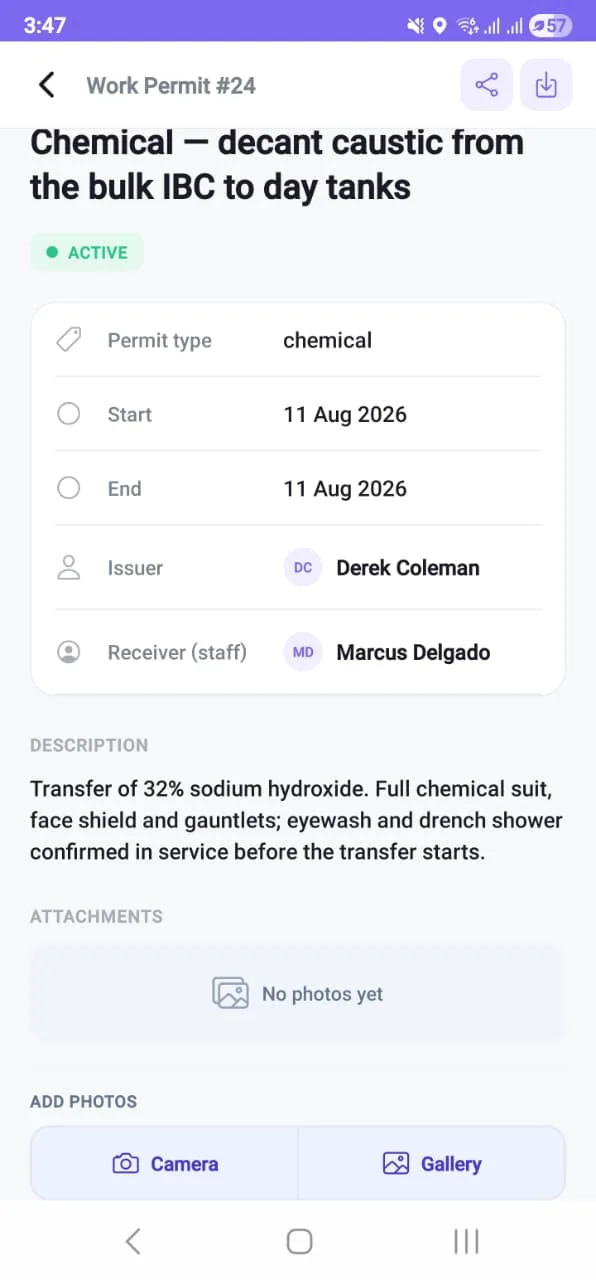
#24 · Chemical · 11 Aug 2026
Active — the controls are named
Transfer of 32% sodium hydroxide. Full chemical suit, face shield and gauntlets; eyewash and drench shower confirmed in service before the transfer starts.
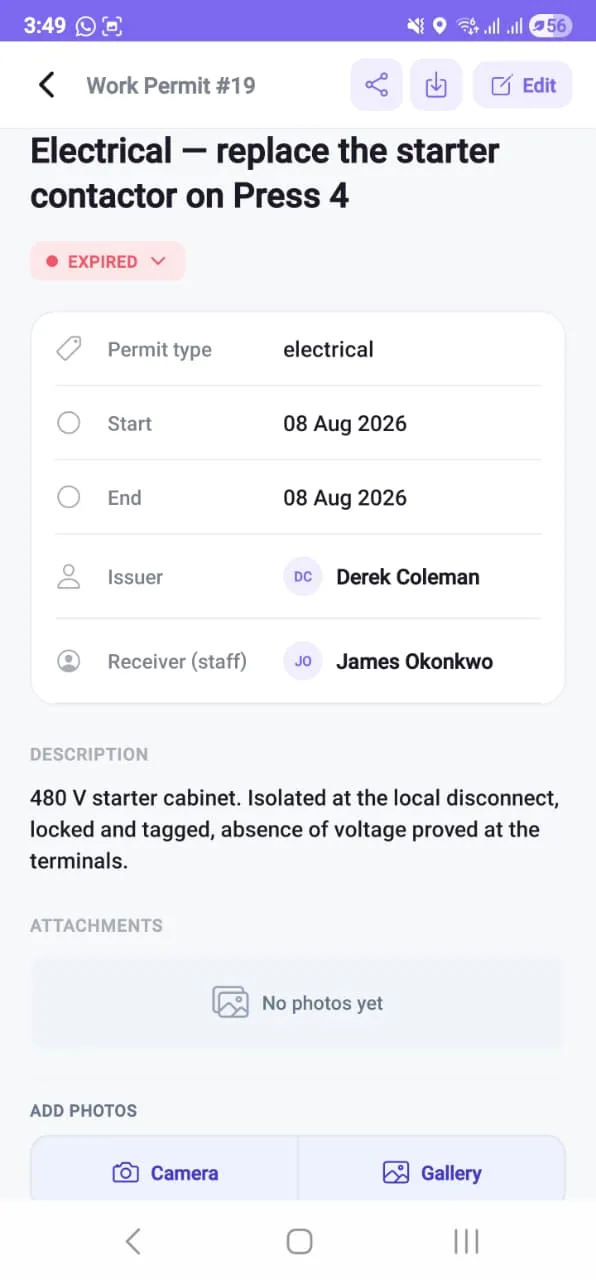
#19 · Electrical · 08 Aug 2026
Expired — nobody closed it
480 V starter cabinet. Isolated at the local disconnect, locked and tagged, absence of voltage proved at the terminals.
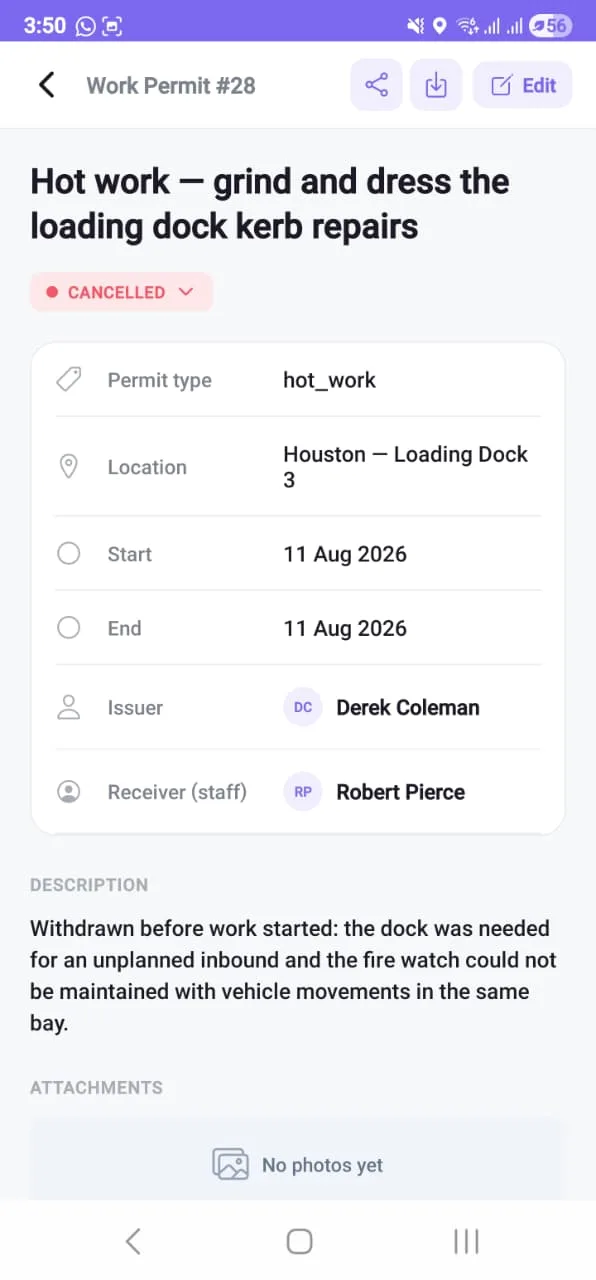
#28 · Hot work · 11 Aug 2026
Cancelled — and the reason is the record
Withdrawn before work started: the dock was needed for an unplanned inbound and the fire watch could not be maintained with vehicle movements in the same bay.
The third one is the one worth reading twice. A hot-work permit withdrawn because the fire watch could not be maintained is a permit system doing its job — and the reason is on the record, so nobody has to reconstruct the decision later from memory.
Nobody approves their own
This is the control. Everything else on this page is administration around it — and it is the first thing to check in any product you are shown.
| Group | Grant on permits | Can request | Can approve |
|---|---|---|---|
| Site Supervisors | Request only | Yes | No |
| HSE Manager | Sign — never own request | No | Yes |
| Contractors | View own permit | No | No |
| Clinic Staff | No access | No | No |
Read out of the same permission model the rest of the site describes. The HSE Manager’s grant is literally “Sign — never own request” — self-approval is not a setting that can be switched on, for anybody, including an administrator.
Four things, and only one of them is a refusal
Three conveniences and one hard stop. The hard stop is the one worth buying.
It routes to the approvers the template defines
Not to a distribution list, and not to whoever is nearest. A hot-work permit for Bay 4 goes to the people the hot-work template names for that area, every time, so the approval path is a property of the work rather than of who happened to be asked.
It refuses the transition
A permit becomes active only with every required signature on it. There is no override, no "activate anyway", and no admin who can set the status by hand. The API refuses it too, which matters more than it sounds — most bypasses are not malice, they are somebody helping.
It lets the signature happen where the work is
The area authority signs from the floor, standing at the job, reading the controls in front of them. A signature collected at a desk is a signature about a description of the work.
It remembers the expiry
Holders and the issuer are notified as the permit nears its end. Work stops or the permit is extended, deliberately and with a name on the extension — rather than a crew working past an expiry nobody was watching.
None of those four is a control in the hierarchy. Elimination, substitution, engineering, administrative, PPE — a permit is administrative, and the software is not even that. It routes, it refuses, and it remembers. The gas test is what keeps somebody alive.
Two clocks, and the platform watches both
A permit and a gas reading both go out of date, and they do it on different schedules.
The permit’s window
It expires on its own, on the site’s clock, whether or not anyone has the page open. Permit #19 above is Expired because its window closed — nobody closed it.
A permit reading “active” three days after the job finished is worse than no permit at all, because it makes the whole register a lie: once one row is wrong, nobody trusts the other twenty-one.
The gas reading’s life
A test answers “is it safe in there now”, and the answer decays. The 05:45 reading in section two was true when it was taken and would have been useless by mid-morning.
So the permit carries whether its current reading is still inside the re-test window, and says so plainly when it is not — rather than showing a number from six hours ago as though it were a fact about right now.
One thing to be straight about: the permits in the captures above carry a start and end date. Windows to the minute, and the re-test clock described here, are configuration this build does not yet show on the record screen — ask to see both in the walkthrough rather than taking this page’s word for it.
Hot work in Bay 4, approved in minutes
07:50. A contractor crew needs to cut and weld beside a fuel line. The permit cannot be a formality, and it cannot take all morning.
07:52
DASHBOARD
The permit is raised
Hot work, Bay 4, with the gas test, the risk assessment and the crew attached. It routes to the approvers the template defines.
08:05
FIELD APP
The area authority signs from the floor
Awaiting Me on the phone. He is standing at Bay 4, not at a desk — he reads the controls and signs.
08:06
AUTOMATIC
Status is enforced, not trusted
Only with every required signature does the permit become active. The platform refuses the transition otherwise.
08:07
FIELD APP
The crew is cleared to start
Their phones show the permit active, its expiry, and the exact area it covers.
16:00
AUTOMATIC
Expiry is not a memory test
As the permit nears expiry the holders and the issuer are notified. Work stops or the permit is extended — deliberately.
Fifteen minutes from request to active permit, with named signatures and a timestamp on each. The same document that authorised the work is the evidence file afterwards.
And the permit nobody calls a permit
A scaffolding crew is permitted for the North Yard only. At 10:20 one of them takes a shortcut through the tank farm. Site-access control that works at the boundary rather than at the gatehouse log. Contractor incidents, treatment and breaches sit in the same register as your own — which is how the regulator counts them.
Both days, minute by minuteWhat an auditor asks, and what you hand them
Clause by clause, the record this module produces — not a claim that it makes you compliant.
| Clause | What it asks for | What the permit hands over |
|---|---|---|
| 8.1.2 | Hierarchy of controls | The controls a permit requires, recorded against the job before it starts |
| 8.1.3 | Management of change | An approval workflow with named signatures — the permit is the change record |
| 8.1.4 | Procurement & contractors | Contractors working under a site-access permit scoped to areas, people and dates |
| 7.2 / 7.3 | Competence & awareness | Competence checked before a permit is issued, not after an incident asks |
| 7.4 | Communication | Approvers notified on request, holders notified before expiry |
| 7.5 | Documented information | The document that authorised the work is the evidence file afterwards |
| 5.4 | Consultation & participation of workers | The area authority signs where the work is, from their own phone |
| OSHA 29 CFR 1910.146 | Permit-required confined spaces | Atmospheric testing recorded against the permit with its time and its tester, the entry conditions it was judged against, and the permit’s duration |
| OSHA 29 CFR 1910.252 | Welding, cutting and brazing | Hot-work authorisation and the fire-watch conditions on the hot-work type’s own fields |
| NFPA 51B | Fire prevention during hot work | A hot-work permit programme with the permit, its area and its watch on one record |
8.1.2
Hierarchy of controls
What the permit hands over
The controls a permit requires, recorded against the job before it starts
8.1.3
Management of change
What the permit hands over
An approval workflow with named signatures — the permit is the change record
8.1.4
Procurement & contractors
What the permit hands over
Contractors working under a site-access permit scoped to areas, people and dates
7.2 / 7.3
Competence & awareness
What the permit hands over
Competence checked before a permit is issued, not after an incident asks
7.4
Communication
What the permit hands over
Approvers notified on request, holders notified before expiry
7.5
Documented information
What the permit hands over
The document that authorised the work is the evidence file afterwards
5.4
Consultation & participation of workers
What the permit hands over
The area authority signs where the work is, from their own phone
OSHA 29 CFR 1910.146
Permit-required confined spaces
What the permit hands over
Atmospheric testing recorded against the permit with its time and its tester, the entry conditions it was judged against, and the permit’s duration
OSHA 29 CFR 1910.252
Welding, cutting and brazing
What the permit hands over
Hot-work authorisation and the fire-watch conditions on the hot-work type’s own fields
NFPA 51B
Fire prevention during hot work
What the permit hands over
A hot-work permit programme with the permit, its area and its watch on one record
Sentinel supports evidencing these requirements. Certification is an audit of your organisation, not of software — no product can be bought to pass one. And the standards above are the authority on your entry conditions, not this page.
The eleven things you are already thinking
Then answer this from where you are sitting: which permits are live right now, and when was each one’s last gas test? A book is a fine place to write a permit down and a bad place to ask a question of. It also cannot refuse to become active when a signature is missing, which is the one thing a permit system is for.
Nor are most, and nothing here assumes otherwise. The reading is typed at the hole in a few seconds, and the platform supplies what a person standing there cannot: the time it was taken and who took it, captured automatically, and the verdict against your entry limits in words. “Oxygen 18.4% is below the 19.5% minimum.” is a sentence somebody can act on — a red square is not.
Fair, and worth being specific about rather than waving away. Ask us exactly what happens on a weak connection during the walkthrough — which parts hold locally, what syncs when, and what the record looks like in between — and hold us to a specific answer. A vendor who tells you connectivity does not matter for a permit system has not run one.
Yes, per site. The defaults on this page are 4 common ones and your entry procedure outranks every one of them. The verdict is frozen against the limits that applied at the moment of entry, so changing a limit next quarter never silently re-scores a reading somebody already made a decision on.
Captured on the hot-work type’s own fields, alongside the rest of that type’s conditions — a confined-space permit should not be asking about a fire watch, and a hot-work permit should not be asking about an attendant. Permit #28 on the register above was cancelled precisely because the fire watch could not be maintained with vehicles moving in the same bay, and that reason is on the record rather than in somebody’s memory.
Good — the signature should not happen at a desk. The area authority signs from the phone while standing at the job, reading the controls in front of them. A permit signed from an office is a signature about a description of the work rather than about the work.
No. A permit becomes active only with every required signature, the platform refuses the transition otherwise, and the API refuses it too. If that is a problem on a given day, the answer is a shorter approval path configured in advance — not a way around the one on the screen.
No, and this is the part worth checking in any product you look at. Requesting and approving are separate grants: Site Supervisors hold request only on permits, and the HSE Manager's approval grant reads "Sign — never own request". Self-approval is not a setting that can be turned on.
The holders and the issuer are notified before it does. Then somebody decides: work stops, or the permit is extended by a named person at a recorded time. What does not happen is a crew carrying on under a permit that quietly ended an hour ago, which is the state most paper systems are in most afternoons.
No. A gas test makes the work safe. An isolation makes the work safe. A permit records that somebody competent looked at the job, decided which of those were needed, and put their name to it — and afterwards it is the evidence that the decision was made before the work rather than reconstructed after it.
Yes, including on your own infrastructure. Permissions are granular — view, create, update, delete and approve are separate grants per module — and every signature is attributed in the audit trail on the site’s own clock.
See it on your own permit types.
Send us the permits you actually issue — hot work, entry, electrical, whatever your site calls them — and who signs each one. We will build the templates and show you a permit going from request to active, with the refusal in the middle.
Forty-five minutes, your scenarios, no slides.