Skip to content
SentinelHSE
A day on site

Nine working days, with the clock running.

Not feature lists. The same nine situations an HSE lead lives through every week, traced step by step across the phone and the dashboard — with the timestamps.

Field app

What the crew does, one-handed, on a cheap handset with a weak signal.

Command centre

What the office sees — the same record, the same moment, no upload step.

Automatic

What the platform does with nobody watching: routing, chasing, escalating.

The timeline

Pick a day and watch the clock

Field app on one side, command centre on the other, and the things the platform does by itself down the middle.

Nine real working days

The near miss that did not get lost

Loading bay, 09:15. A pallet shifts as a forklift reverses. Nobody is hurt — and that is exactly the report that usually never happens.

09:15

1 / 5

  1. Field app09:15

    Yusuf opens the app and taps Report

    Near Miss, category Vehicle/Pedestrian. GPS picks Loading Bay from the configured sites; he photographs the pallet.

  2. Field app09:16

    Severity: High. Submit.

    Fifty seconds, one hand, gloves on. He walks back to the job.

  3. Automatic09:16

    The rule fires

    High severity raises an alert to the HSE lead and opens the record for assignment — no one had to notice it.

  4. Command centre09:18

    Mariam sees it on the dashboard

    Open near miss, high, unassigned. She reads the photo, assigns a corrective action to the yard supervisor, due today.

  5. Field app09:19

    The supervisor’s phone buzzes

    The action is in My Jobs with the photo and the location attached. He closes it at 11:40 with a photo of the re-stacked pallet.

Near miss

The day where nothing happened

Every other story here starts with something going wrong. This one starts with a pallet that did not fall on anybody — and it is the only kind of day where you still have a choice about the ending.

  1. 0109:15
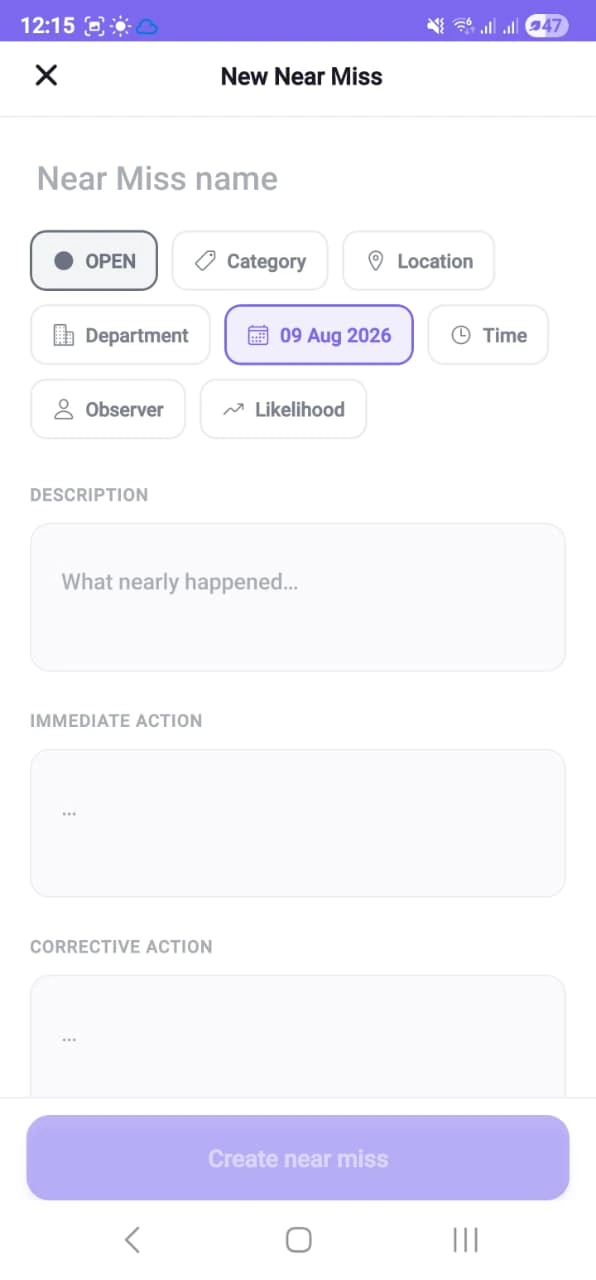
    The new near-miss form on a phone, with category, location, department, date, observer and likelihood

    Filed where it happened

    Category, area and observer, and a photograph of the pallet. Location and time arrive pre-filled, so the only typing is what nearly happened.

  2. 0209:16
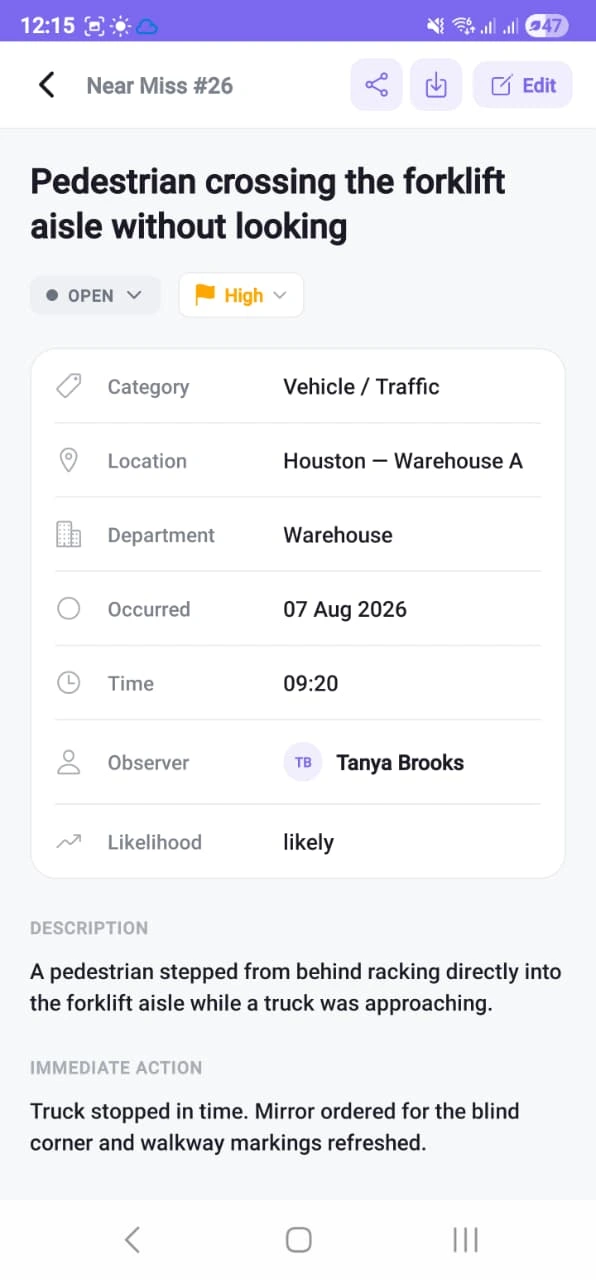
    A near-miss record on a phone, rated High, showing the observer, the likelihood and the immediate action taken

    Ranked by what could have happened

    Potential severity times likelihood gives a score, and the score decides whose week it belongs in. Nobody was hit; it is still High.

  3. 0311:40
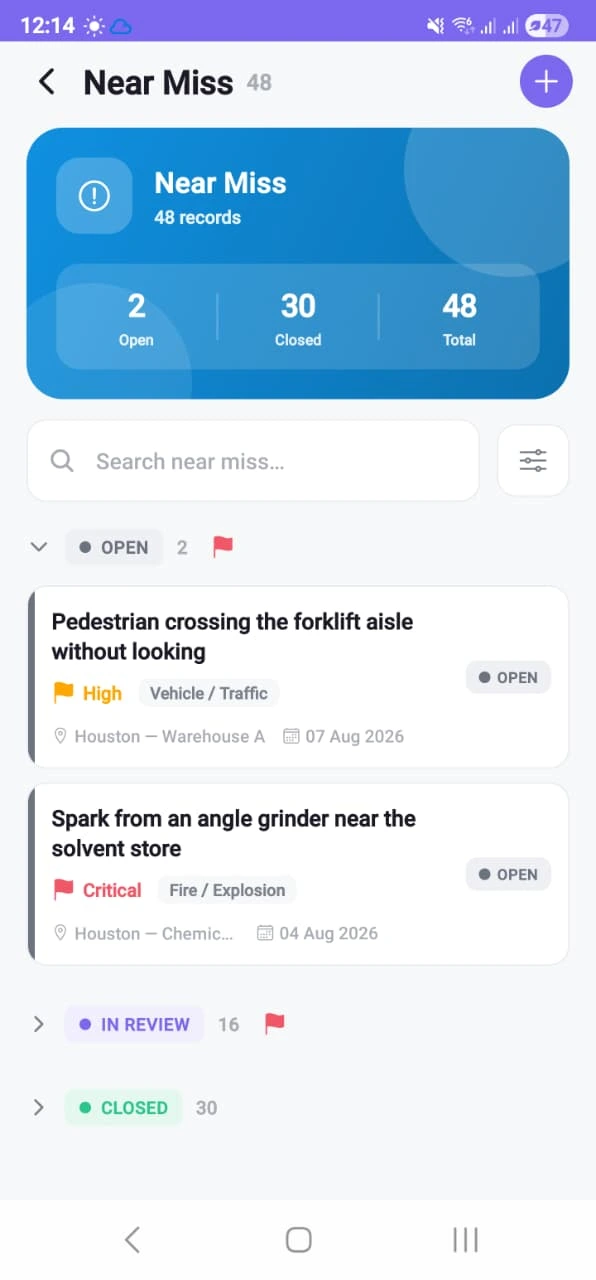
    The near-miss list on a phone, grouped into open, under review and closed

    And the reporter sees it close

    Grouped by state, so what is still open is the first thing anyone opens — including the person who filed it. That is what makes a second report happen.

On paper: a note that reaches a desk at 17:40, if it reaches one at all — and a manager who learns about the aisle after somebody is standing in it.

How near-miss reporting works

In the illustrative month behind these screens there were 48 near misses and 14 incidents — about 3.4 reports for every event that actually happened. A rising count there is a programme working, not a site getting worse, and your board needs to be told that before the first spike rather than during it.

First aid readiness

The round with no event to trigger it

Every other day on this page begins with something happening. A first-aid round begins with nothing happening, to a cabinet nobody has opened since May — which is precisely why it is the one that gets skipped.

  1. 01Due date
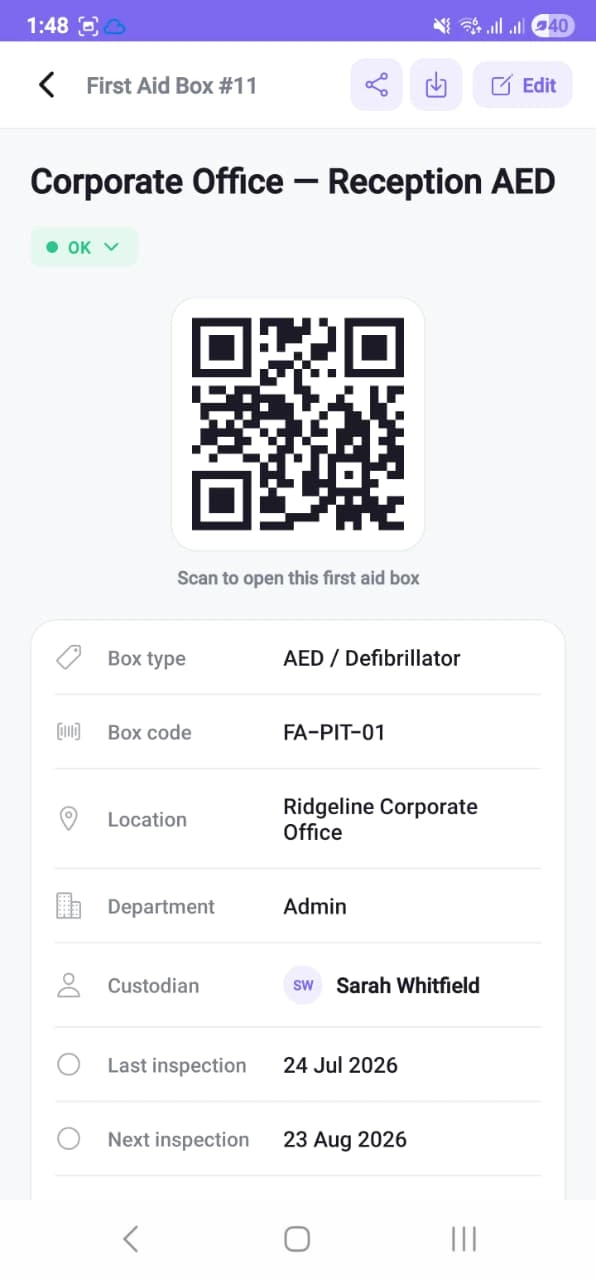
    A first-aid station record on a phone, showing its QR label, type, code, location, custodian and inspection dates

    The cabinet asks for itself

    The station reaches its date and lands on the custodian’s list. Scanning the QR label on the door opens this record — not the one next to it.

  2. 0209:21
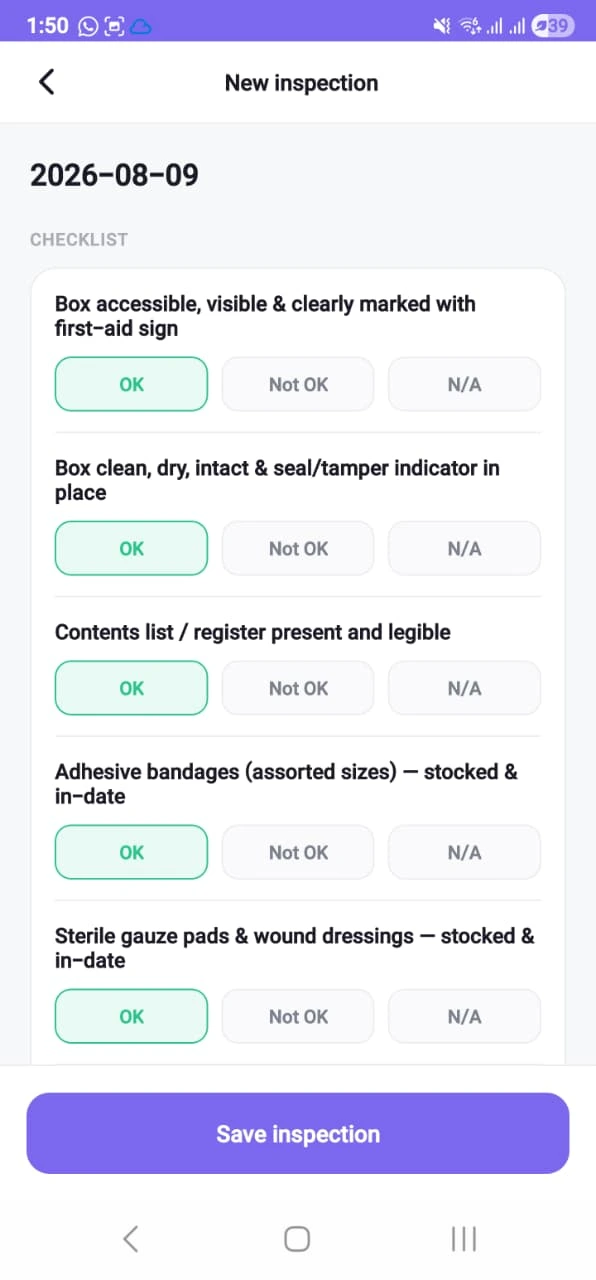
    A first-aid inspection on a phone, with each step offering OK, Not OK and N/A, and OK pre-selected

    Fifteen points, two exceptions

    Every step starts at OK, so a clean kit takes under a minute. Expired burn gel and one pair of gloves get flagged, photographed and saved at the cabinet.

  3. 03Afterwards
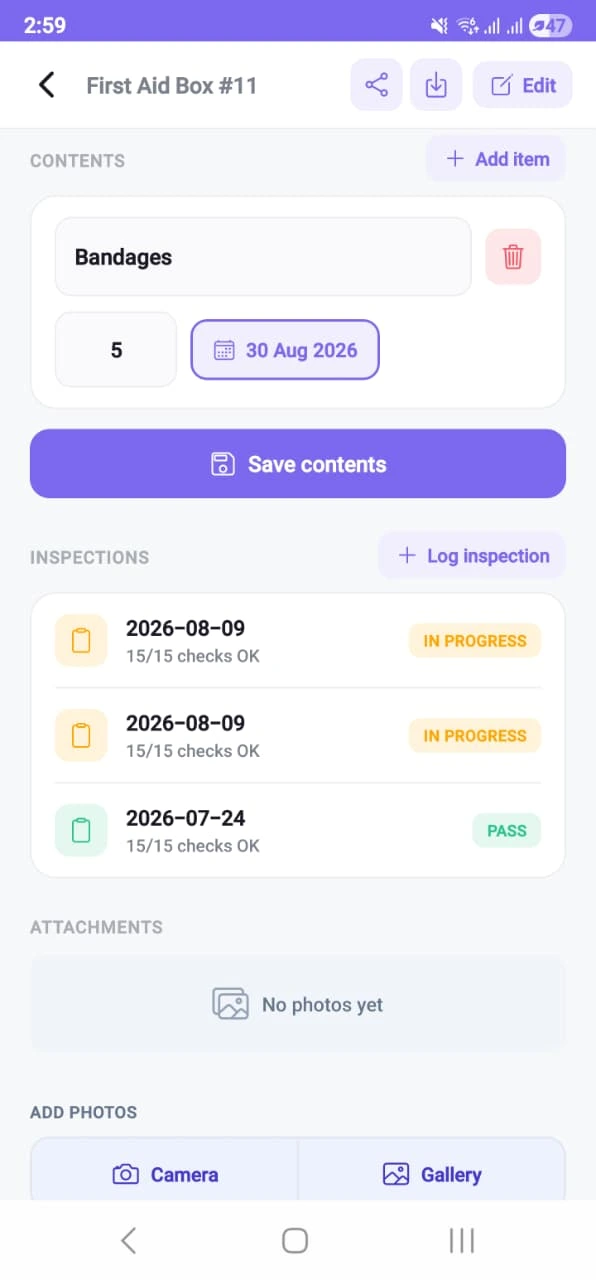
    A first-aid station record on a phone showing its contents with quantities and expiry dates, and a list of logged inspections

    The record it leaves behind

    Contents with expiry dates, and every check that ever ran against this cabinet. This is the answer to “when was that kit last checked?”, without walking to it.

On paper: a signature card on the cabinet door, which proves that somebody signed a card. It does not prove the burn dressing was in date, and it cannot tell you this morning which cabinets are overdue.

How first-aid readiness works

Across eleven stations on five illustrative sites, eight were in date and two had gone past. The two were not found by walking the site — they raised themselves, with a name against each one.

Why scenarios

Judge it on a Tuesday, not on a feature grid

Every HSE platform demos well. The question is what happens at 09:15 on an ordinary shift, when nobody is watching and reporting is optional.

The clock is the argument

Fifty seconds to file. Two minutes to the manager’s screen. Fifteen minutes to an active permit. Twenty minutes to an audit pack. Those gaps are the product.

Nothing is re-keyed

Naming an injured person opens their medical file. A failed check raises an action. Closing an incident resolves the hazard zone. One record, seen from different sides.

The evidence is a by-product

Nobody assembles an audit pack in these stories. It already exists, because the work was done in the system rather than written up afterwards.

The fastest way to judge an HSE platform is to file one real report on a phone and watch what reaches the manager. That takes about fifteen minutes.

Book a live walkthrough

Run one of these on your own site

A four-week pilot with one crew, on your real categories and your real sites. Then count the near misses reported.

45-minute walkthrough first, if you would rather look before you commit.