Skip to content
SentinelHSE
Incident management

When something goes wrong, the clock starts.

Capture an incident in under a minute from the floor. Classify it, investigate it, assign the corrective actions and close them out — with a complete evidence chain from first report to verified fix.

The report you never received is the one that costs you.

A recordable injury does not stop at the medical bill. It moves your TRIR, and your TRIR is the number a client's procurement team reads before they award the contract. It invites the regulator, the insurer, and — after a serious event — a question no manager wants: show us what you knew, and when.

Most sites cannot answer quickly. The incident is in a supervisor's notebook. The investigation is in an email thread. The corrective action is in someone's head. Each piece exists; nothing connects them. When the auditor asks for the chain, somebody spends three days rebuilding it.

A low near-miss count is not safety. It is silence.
Capture

Friction decides what gets reported

If reporting means finding a laptop, opening a form with forty mandatory fields and chasing a signature, the small stuff never gets logged — and the small stuff is the early warning.

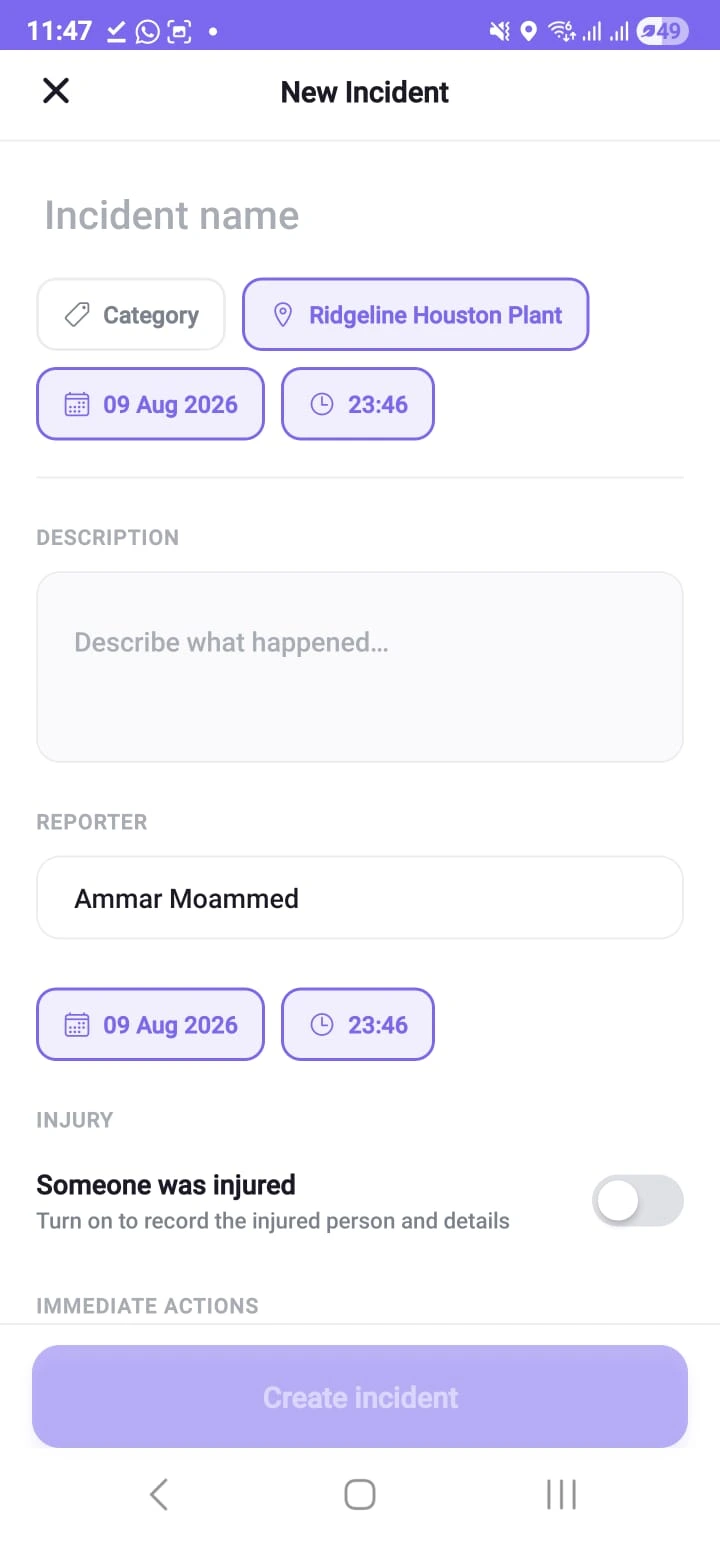
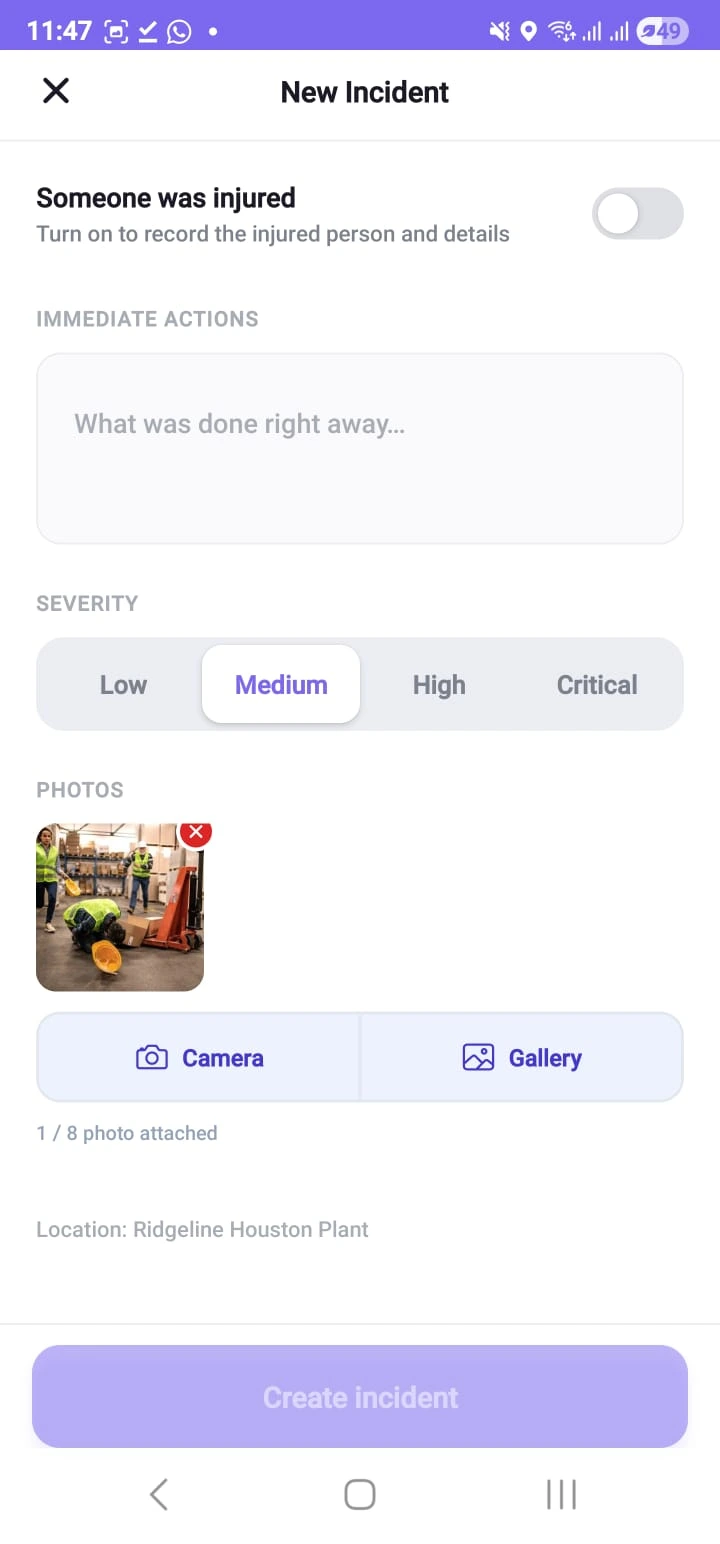
This is the whole form, every field of it. Hover a card to light that control on the screen — or hover the screenshots themselves to magnify them, and click to open one full size.

The New Incident form: name, category, an already-filled location chip reading Ridgeline Houston Plant, stamped occurrence date and time, description, reporter, reporting date and time, and an injury toggle

What happened, and where

The lower half of the New Incident form: immediate actions, a four-step severity selector set to Medium, an attached photograph of the scene, camera and gallery buttons with an attachment counter, the detected location, and the create button

What was done, and the proof

Screenshots from a working build. The photograph and the location are illustrative.

Under a minute, one hand

On a cheap Android, in gloves, without going to find a laptop. If reporting takes longer than the walk back to the job, it does not get filed.

Precise enough to fix

Locations resolve to the area, not the postcode: Warehouse A, Aisle 4 rather than “Houston Plant”. A trend you cannot locate is a trend you cannot act on.

A weak signal is expected

The report is captured on the device and syncs when the phone finds a bar. Nobody has to walk to the office to make a report go through.

Fields are configuration

An administrator removes a field, renames a category or changes a severity level. No development ticket, no release. Forty mandatory fields is how reporting dies.

The command centre

Where it lands, before the reporter is back at the job

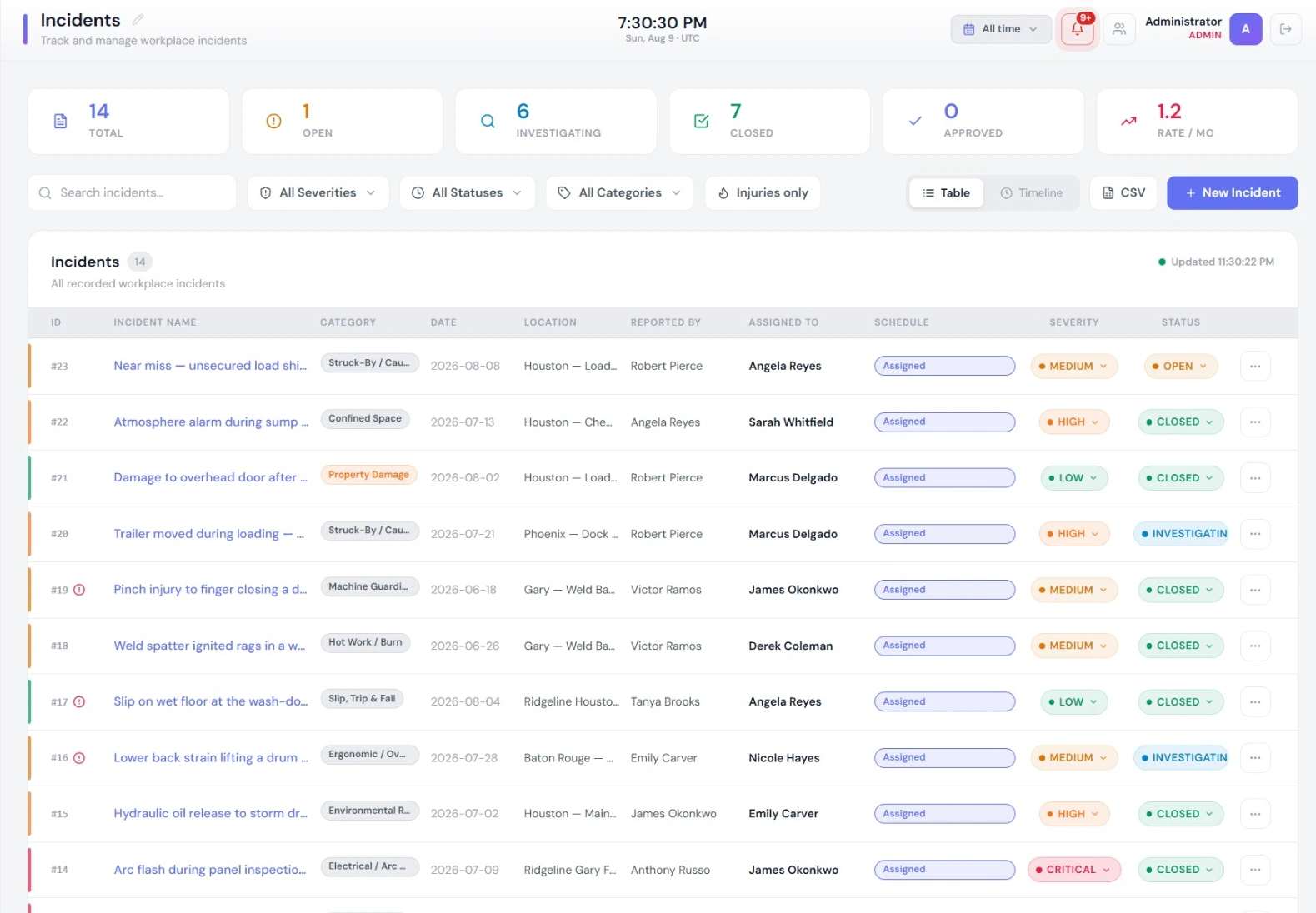
The fifty seconds a supervisor spent on a phone become a row on a manager’s screen — counted, filterable, and owned by someone with a name against it.

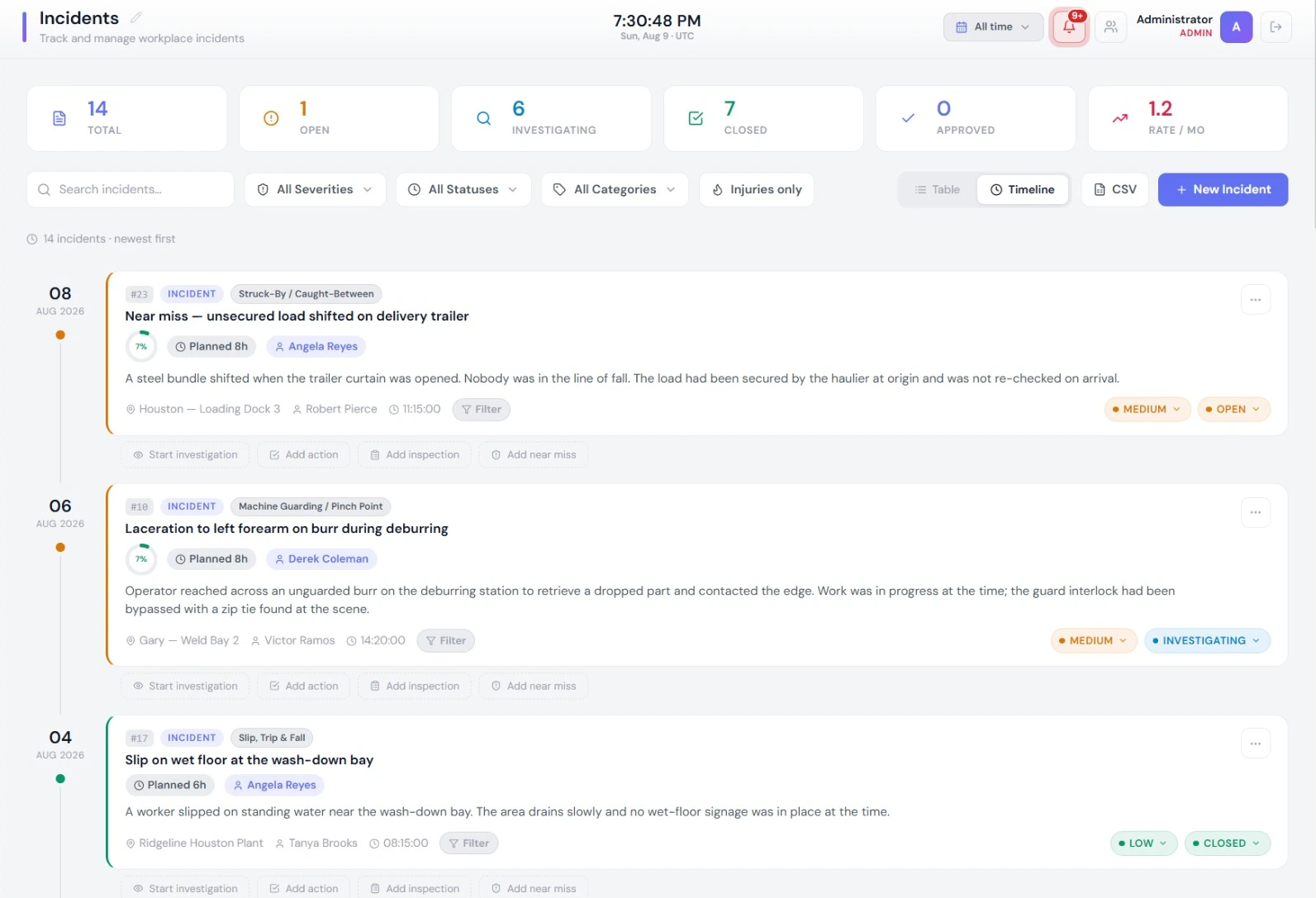
The SentinelHSE incident register: six counters across the top, filters for severity, status and category, and fourteen events with owner, severity and status on every row

The counters are the stand-up

Total, open, investigating, closed, awaiting approval, and the rate per month. The first question in a Monday meeting, answered before anyone asks it.

Triage without opening the record

Severity and status are editable in the row. Reassigning a dozen events after a walkaround takes a dozen clicks, not a dozen page loads.

Table or timeline, same events

The table is for working through a backlog. The timeline is for showing someone what a month actually looked like. Injuries-only is one more filter.

CSV out, whenever

Whatever is on screen after filtering is what exports. Your data leaves in a format that opens anywhere — which is also what leaving looks like, if you ever do.

Screenshot from a working build. Illustrative records — not a customer.

The register

One register. Every event.

Filterable by site, category, severity and status. A live register from a working month — filter it here and see what a month of your own would look like.

Incident register

One working month across four sites

Illustrative data — not a customer
Severity
  • #13
    CriticalInvestigating

    Fall from mobile scaffold — fractured wrist

    Date
    Jul 16
    Category
    Fall from Height
    Site
    Houston — Warehouse A
    Classification
    Lost time (DART)
  • #14
    CriticalClosed

    Arc flash during panel inspection

    Date
    Jul 09
    Category
    Electrical / Arc Flash
    Site
    Gary Fabrication
    Classification
    High-potential, no injury
  • #12
    HighInvestigating

    Caustic splash to face during drum decanting

    Date
    Jul 24
    Category
    Chemical Exposure
    Site
    Baton Rouge — Drum Storage
    Classification
    Medical treatment
  • #15
    HighClosed

    Hydraulic oil release to storm drain (~40 gal)

    Date
    Jul 02
    Category
    Environmental Release
    Site
    Houston — Maintenance Shop
    Classification
    Reportable release
  • #18
    HighInvestigating

    Trailer moved during loading — dock plate dropped

    Date
    Jul 21
    Category
    Struck-By / Caught-Between
    Site
    Phoenix — Dock Apron
    Classification
    Near miss
  • #11
    HighInvestigating

    Forklift struck racking upright, aisle 4

    Date
    Jul 31
    Category
    Vehicle & Mobile Equipment
    Site
    Houston — Warehouse A
    Classification
    Property damage
  • #17
    HighClosed

    Atmosphere alarm during sump entry

    Date
    Jul 13
    Category
    Confined Space
    Site
    Houston — Chemical Yard
    Classification
    High-potential, control worked
  • #16
    MediumInvestigating

    Lower back strain lifting a drum unassisted

    Date
    Jul 28
    Category
    Ergonomic / Overexertion
    Site
    Baton Rouge — Drum Storage
    Classification
    Restricted work (DART)
  • #10
    MediumInvestigating

    Laceration to forearm during deburring

    Date
    Aug 06
    Category
    Machine Guarding
    Site
    Gary — Weld Bay 2
    Classification
    First aid only
  • #19
    MediumClosed

    Pinch injury to finger closing a die

    Date
    Jun 18
    Category
    Machine Guarding
    Site
    Gary — Weld Bay 2
    Classification
    Medical treatment

Showing 10 of 10 rows — ten of 14 events in the period. 4 were OSHA-recordable; 2 were high-potential events with no injury at all — the ones a register based on outcome alone would never surface.

The same register, in the hand

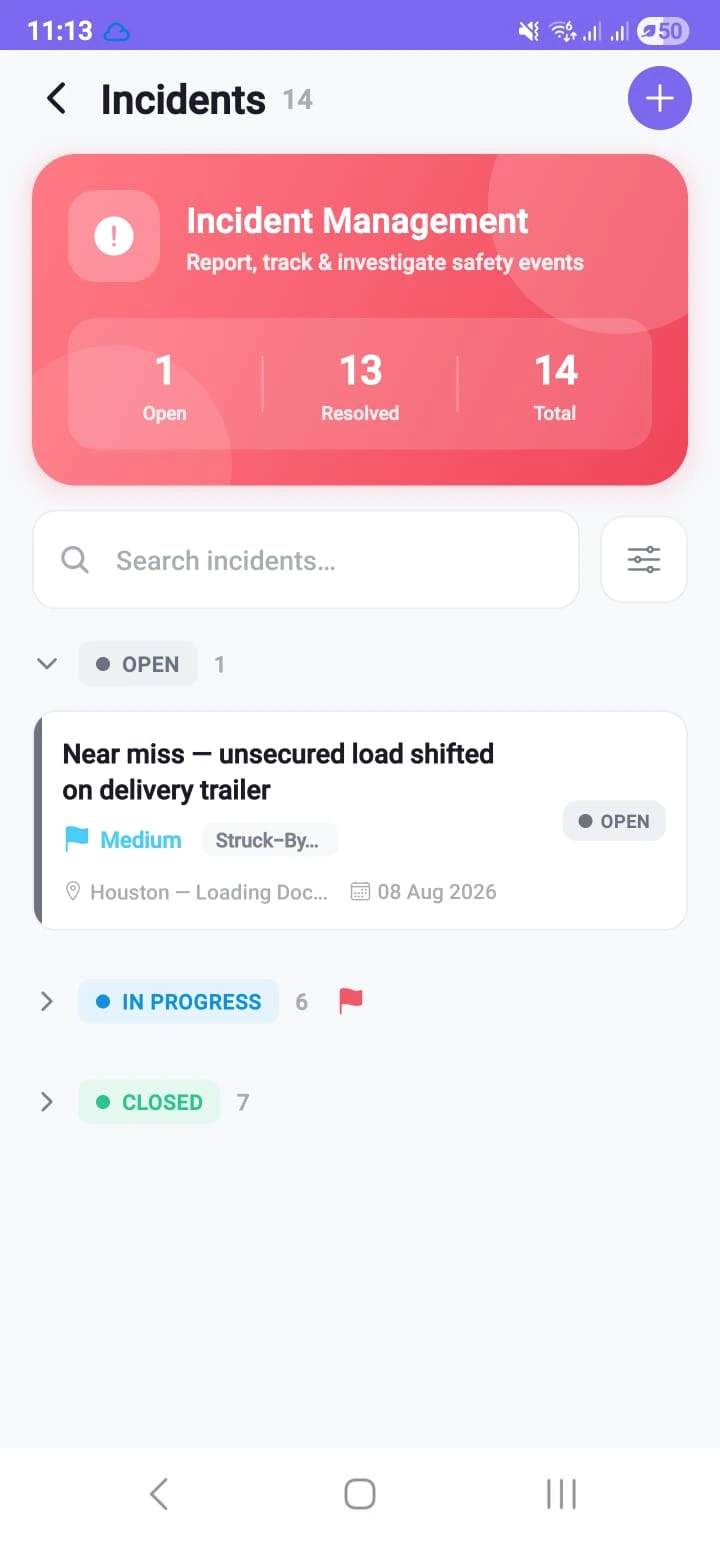
Not a cut-down version and not a separate database — the same events, grouped by what still needs doing. A supervisor opens one and gets the category, the location, the reporter and the description that was written at the scene.

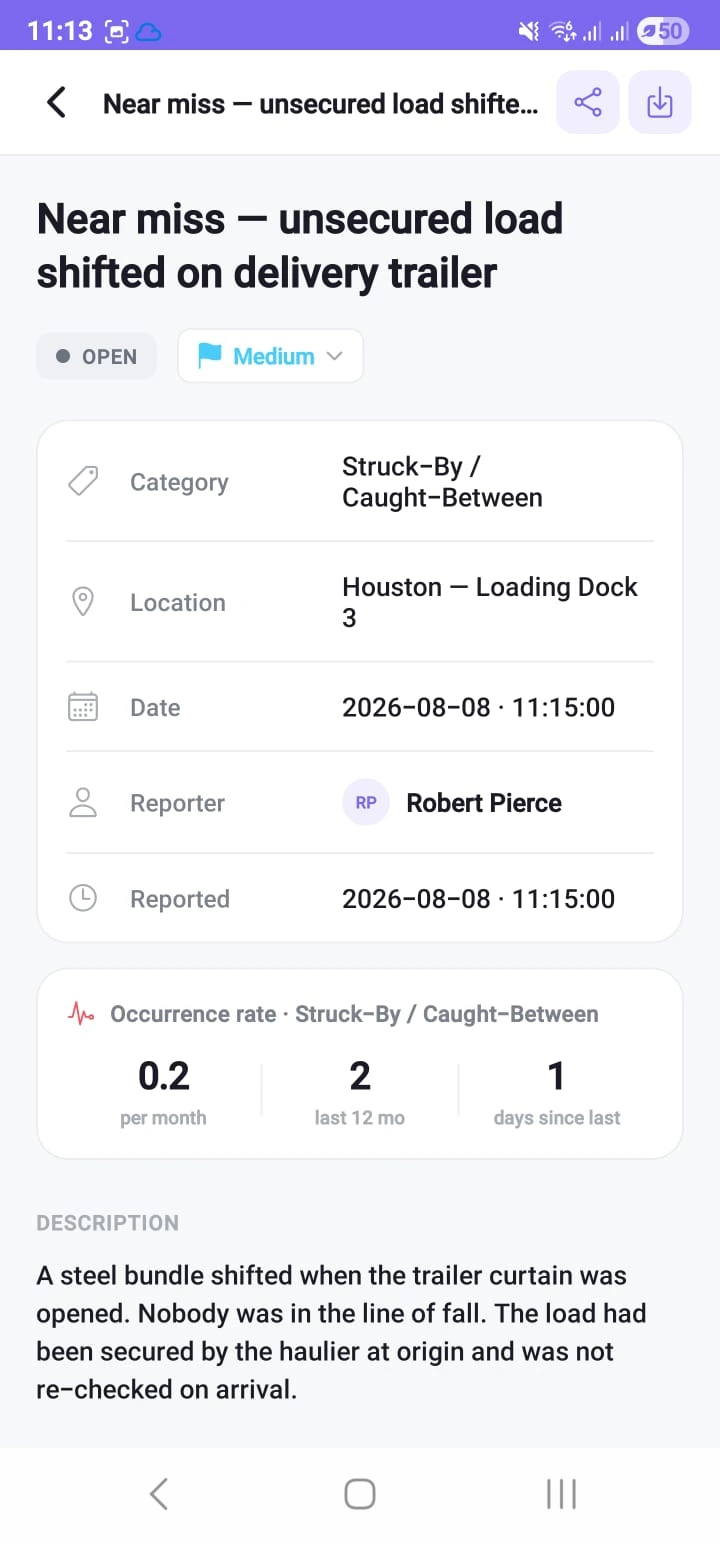
The strip under the header is the part managers use most: how often this category occurs, how many in the last twelve months, and how many days since the last one. That is the difference between logging an event and noticing a pattern.

The field app incident list: fourteen events grouped into open, in progress and closed, each with severity and location
An incident on the phone: category, location, date, reporter, the occurrence rate for that category and the full description
Timeline view

The same register, with one row opened

A table answers what happened this month. The timeline answers what happened to one of them — the file, the two causes, and every action still owed, hanging off the incident instead of sitting in three other systems that have to be joined by hand.

Timeline view · newest first

Illustrative data — not a customer

06

Aug 2026

#10INCIDENTMachine Guarding / Pinch Point3 open actions

Laceration to forearm during deburring

255%Planned 8hTanya Brooks

Operator reached across an unguarded burr on the deburring station to retrieve a dropped part and contacted the edge. Work was in progress at the time; the guard interlock had been bypassed with a zip tie found at the scene.

Gary — Weld Bay 2Victor Ramos14:20
MediumInvestigating
Investigation #1

Open

Opened

06 Aug 2026

Immediate cause

Operator reached across the deburring wheel to clear swarf while the spindle was still coasting down; the cuff of the sleeve caught the burr edge and drew the forearm onto it.

Root cause

The deburring cell was re-sited in June and the JHA was never re-run for the new layout, which put the swarf tray on the far side of the wheel. Clearing it from the near side meant reaching over the rotating tool, and because the cell had no owner for its pre-use check, the workaround became the normal method.

Category details — Machine Guarding / Pinch Point

Injury type

First aid only

Guard state

In place but defeated

Energy isolated

No

Body part

Left forearm

  • Action #20Restore and function-test the guard interlock on the deburring wheel2d overdueOpen
  • Action #19Re-run the JHA for the relocated deburring cell with the operators who work itIn progress
  • Action #21Assign a named owner to the deburring cell’s daily pre-use checkOpen

Add actionAdd inspectionAdd near miss

One incident from the register above, opened. The investigation and the three corrective actions are the same records the investigations and corrective-actions pages list — bound to the incident, not filed alongside it.

four records, one object

The investigation and the three corrective actions are not copies filed under the incident — they are the rows the investigations and corrective-actions registers list, shown where they belong. Between them they name three people. Nobody had to join anything to see that.

Two causes, two fields

The immediate cause is a sleeve catching a burr edge. The root cause is a cell that moved in June without its job hazard analysis being re-run. Only one of those has an action worth raising against it — which is why the platform keeps them apart, and why it does not write either. People find causes.

The card is already telling on itself

The ring is time booked against the 8 hours this file inherited from its parent incident’s target — at 255% it is running long, and the number says so now rather than at the review. One of the actions below it is past its date. Neither of those is a report somebody has to run.

Classification

Severity is what happened. Potential is what nearly happened.

Classifying only by outcome hides your worst exposures. The arc flash injured nobody — the technician was in arc-rated PPE. The same event without that PPE is a fatality. Recording by potential consequence is what puts it in front of the board.

Lagging

harm already done

TRIRTotal Recordable Incident Rate
recordable cases × 200,000 / hours worked
LTIFRLost Time Injury Frequency Rate
lost-time injuries × 1,000,000 / hours worked
DARTDays Away, Restricted or Transferred rate
per 200,000 hours worked

Every rate here carries its multiplier, because a rate quoted without one is not a rate. These are the numbers your client's procurement team reads.

Leading

harm not yet done

Near-miss ratio
Near misses reported per recordable. Rising is good — it means people are telling you.
High-potential events
Logged by what could have happened, not by who got hurt. The arc flash lives here.
Actions closed on time
The percentage that did not run late. The single best predictor that the last incident will not repeat.

These cost almost nothing to collect once reporting takes a minute — and they are the only ones you can still act on.

The chain

From report to verified closure

The chain an auditor asks for, built as the work happens rather than reconstructed afterwards. Following the scaffold fall at Houston Warehouse A.

The same register as a timeline: each event dated, with its description, owner, location, severity and status, and the next actions available inline
The same events as a timeline. Start an investigation, add an action, add an inspection or log a related near miss without leaving the record.
  1. 1
    Minute 0

    Reported from the floor

    The supervisor logs the scaffold fall on a phone: photo, GPS-resolved area, category, severity. No laptop, no form to find.

  2. 2
    Minute 2

    The right people know

    Severity and site drive the notification. Plant manager and VP HSE are alerted on their phones — not cc’d on an email nobody opens.

  3. 3
    Hour 1

    Triaged and classified

    The injured person is added, and a clinic medical record is created and bound to the incident automatically.

  4. 4
    Day 1

    Made safe

    Immediate actions captured: the scaffold quarantined, mobile scaffold work suspended site-wide. The interim control is on the record, not just in a conversation.

  5. 5
    Day 1–5

    Investigated

    The assigned investigator works the root cause — 5 Whys or fishbone. Findings, contributing factors and evidence photos attach to the same record.

  6. 6
    Day 5

    Controls assigned

    Each cause becomes a corrective action with an owner and a due date, ranked against the hierarchy of controls: engineering before administrative before PPE.

  7. 7
    Ongoing

    Chased automatically

    Overdue actions escalate on their own. Nobody has to remember.

  8. 8
    Day 30

    Closed and verified

    Actions are verified effective before closure. Days away are booked to the roster; the record is complete and exportable.

Connected

One entry. Four modules updated.

The scaffold fall did not stop at the incident record. No re-keying, no second system, no reconciliation — this is where most HSE tools stop being a system and become a filing cabinet.

Clinic

Naming the injured person opens their medical report and binds it to the incident. The nurse records treatment, restriction and follow-up. Clinical notes stay with the clinician.

Attendance

Days signed off by the clinician land on the roster as approved leave, so the absence sweep does not mark an injured man absent without leave.

Job Schedule

The restriction is visible to whoever schedules work, so nobody is assigned a job their injury forbids. This is the failure that turns one injury into two.

Actions

Each root cause becomes a corrective action with an owner and a due date, escalating on its own when it runs late.

One person entered one incident on a phone. Nobody typed it again.

Evidence

What an auditor actually asks for

HSE buyers respond to clause numbers rather than feature lists, because the clause is the artefact they have to produce.

  • ISO 45001:201810.2

    Incident, nonconformity & corrective action

    Where the evidence comes from

    Incident → investigation → root cause → corrective action → verified closure

  • ISO 45001:20189.1

    Monitoring, measurement & analysis

    Where the evidence comes from

    Leading and lagging indicators, per site, exportable

  • ISO 45001:20187.5

    Documented information

    Where the evidence comes from

    Every record retained, retrievable and time-stamped

  • ISO 45001:20185.4

    Consultation & participation of workers

    Where the evidence comes from

    Reporting from the field, by anyone on site

  • OSHA29 CFR 1904

    Recording and reporting occupational injuries and illnesses

    Where the evidence comes from

    Recordability classification and the data behind the log

SentinelHSE supports evidencing these requirements. Certification is an audit of your organisation, not of software — any vendor who tells you their product makes you compliant is selling you a problem.

Objections

The five things you are already thinking

Answered the way we would answer them in the room, including where the risk is real.

Often true, and it is usually the app’s fault. Adoption is the design constraint here: under a minute, one hand, a cheap Android, a weak signal. The honest test is not a demo — run one crew for a month and measure the reporting rate before and after. If it does not move, it has not worked, and you should not roll it out.

Then capture is probably not your problem — retrieval and chasing are. Two questions worth asking your own team: how many days did the last audit pack take to assemble, and which corrective actions are overdue right now? If nobody can answer the second one in under a minute, the spreadsheet is a record, not a control.

Yes. It can run in our cloud, inside your own cloud account under your policies and retention rules, or entirely on your own servers for sites that cannot send safety data outside at all. Everything is exportable, so leaving is a decision you can still make later.

Yes. Categories, severity levels, form fields, approval paths and permission groups are configuration, changed by an administrator without development work. If your site calls it a Safety Observation rather than a Near Miss, the platform should learn your language, not the other way round.

Almost always one of two reasons: too many mandatory fields, so the field stopped reporting; or nobody owned the corrective actions, so the record filled up and nothing changed. Both are addressable, and both are worth diagnosing out loud before you buy anything — including this.

See it on your own data

Bring one month of your incidents. We'll load them and show you the register, the trend and the open-action list your board would see — before you decide anything.

45 minutes. Or run a four-week pilot with one crew and measure the reporting rate yourself.