The round is only worth the hour if the findings outlive it.
A schedule with names against it, findings graded as they are seen, and every one of them turned into owned work before the inspector gets back to the office.
Nobody fakes an inspection. They just stop finding things.
The failure mode is not a forged signature. It is a real walk, done in a hurry, by somebody who already knows what the area looks like. The form gets a tick, the month gets a green square, and the finding that mattered was never written down — because writing it down meant a form back at the desk.
Then the audit asks for twelve months of records and gets twelve months of nothing found. Which is a worse answer than a list of problems, and everybody in the room knows it.
A round that closes clean every month is either a perfect area or an unopened pair of eyes — and the record cannot tell you which.
Grade it where you see it
Four things, and the fourth is the one that decides whether the hour was worth spending.
The round is a record before it happens
An area, a date and a named inspector, booked ahead. A schedule that lives in somebody’s head is a schedule that quietly loses its worst month.
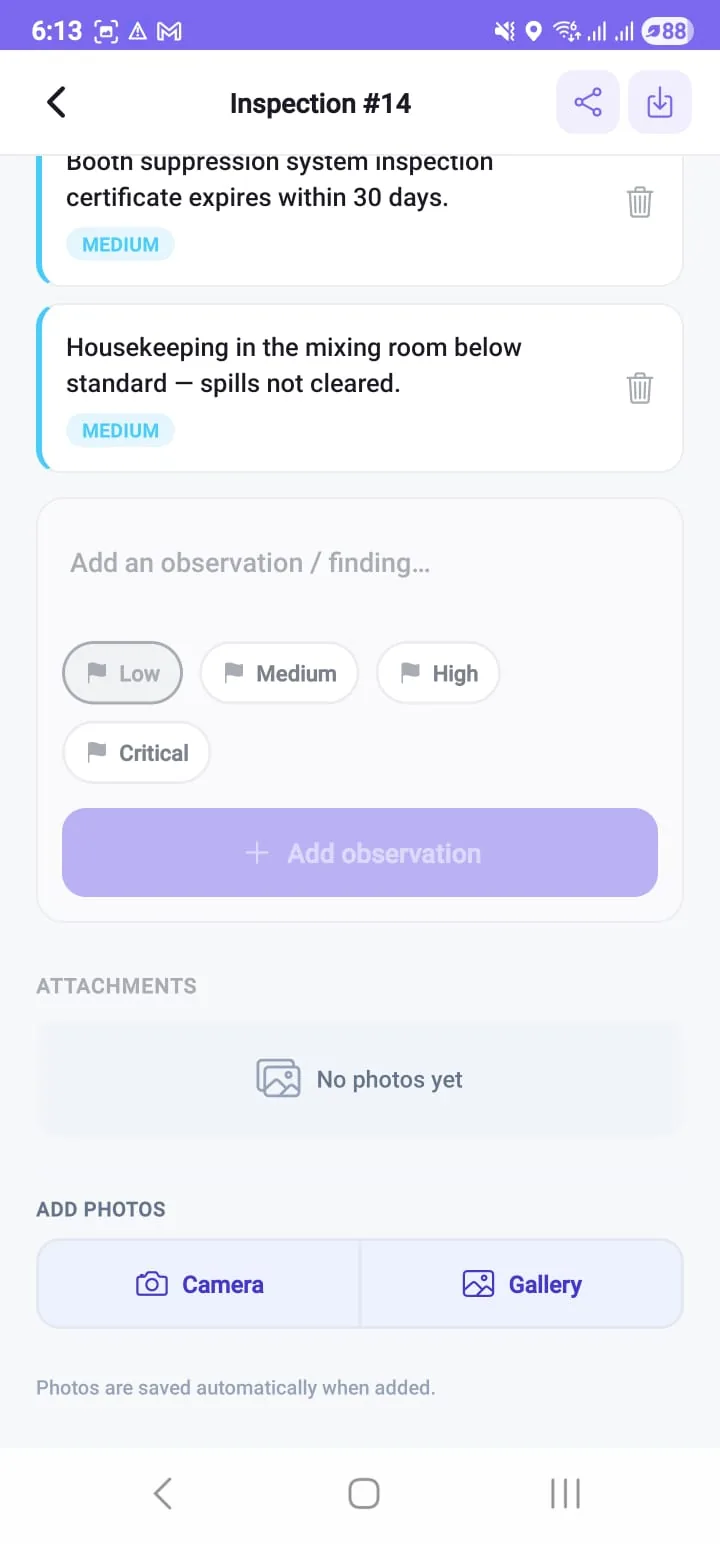
Each finding is its own line
Written at the thing, with its own grade. One free-text box for a whole walk is how four problems become one paragraph nobody can action.
The grade does the triage
Critical and high surface the moment the round completes. Low is still on file — it is what turns a nuisance into a pattern six months later.
Findings become owned work
Into the same corrective-action tracker incidents, near misses and failed equipment checks feed. One queue, one overdue count, one place to look.

A round is a record before it is a walk
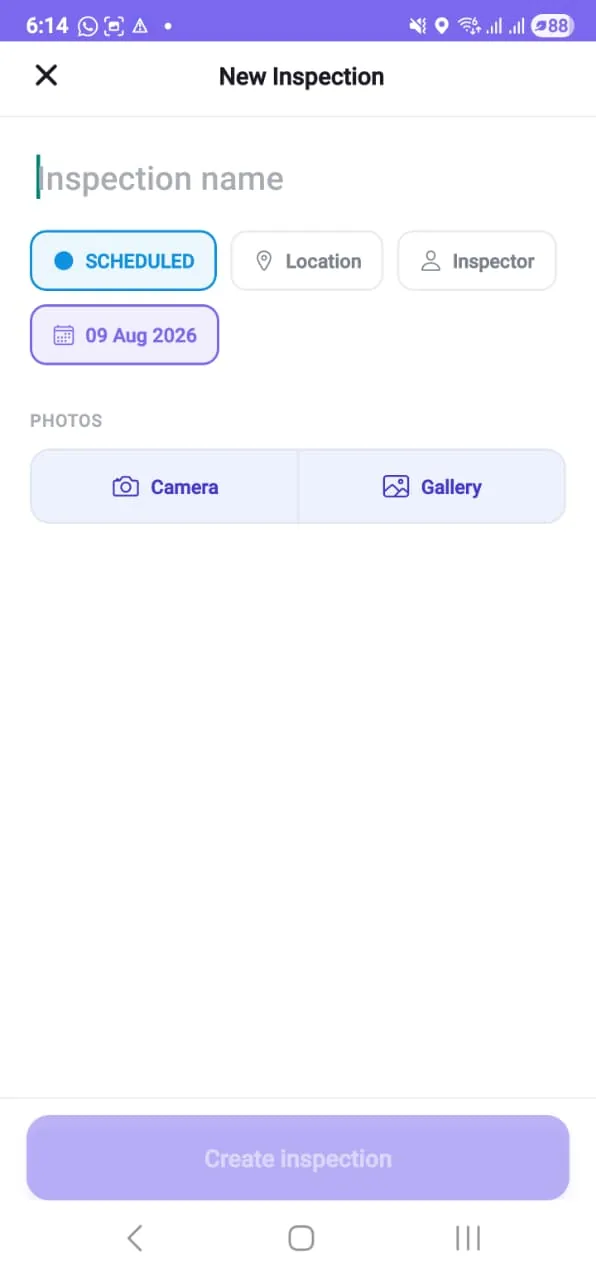
The form opens on Scheduled and asks for the three things that make a round accountable: where, when, and who. All 17 of the rounds in the programme below carry every one of them.
That is the difference between a programme and a habit. A walk that was never booked cannot be missed — it can only be forgotten, and forgetting leaves no record at all.
Three of the rounds shown are still ahead of today, sitting on their inspector's planboard lane without a planner having touched them.
A completed round and the composer that fills one, every control on both. Hover a card to light that control on the screen, or hover the screenshots themselves to magnify them and click to open one full size.
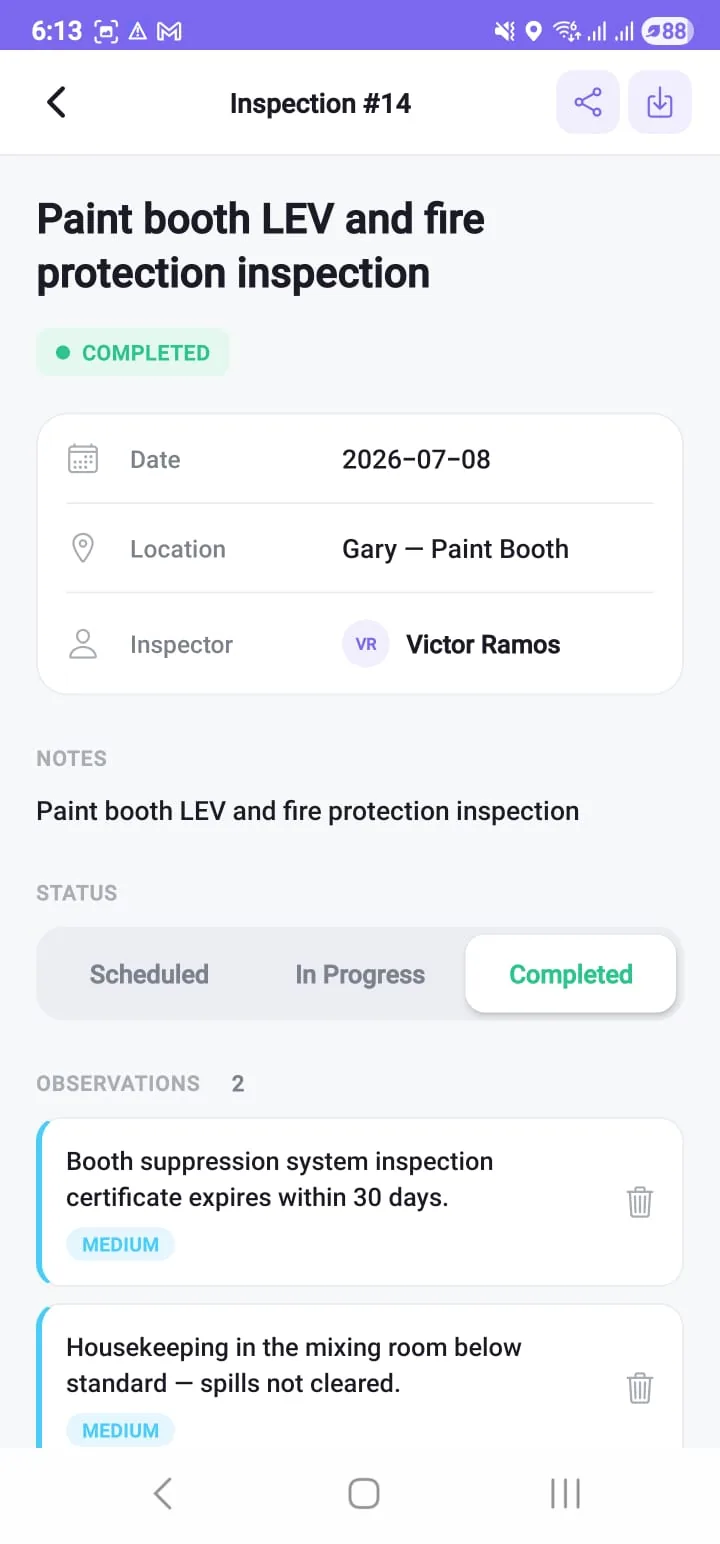
A completed round

Recording what you see
Screenshots from a working build. Illustrative records — not a customer.
26 rounds, eleven areas, one month
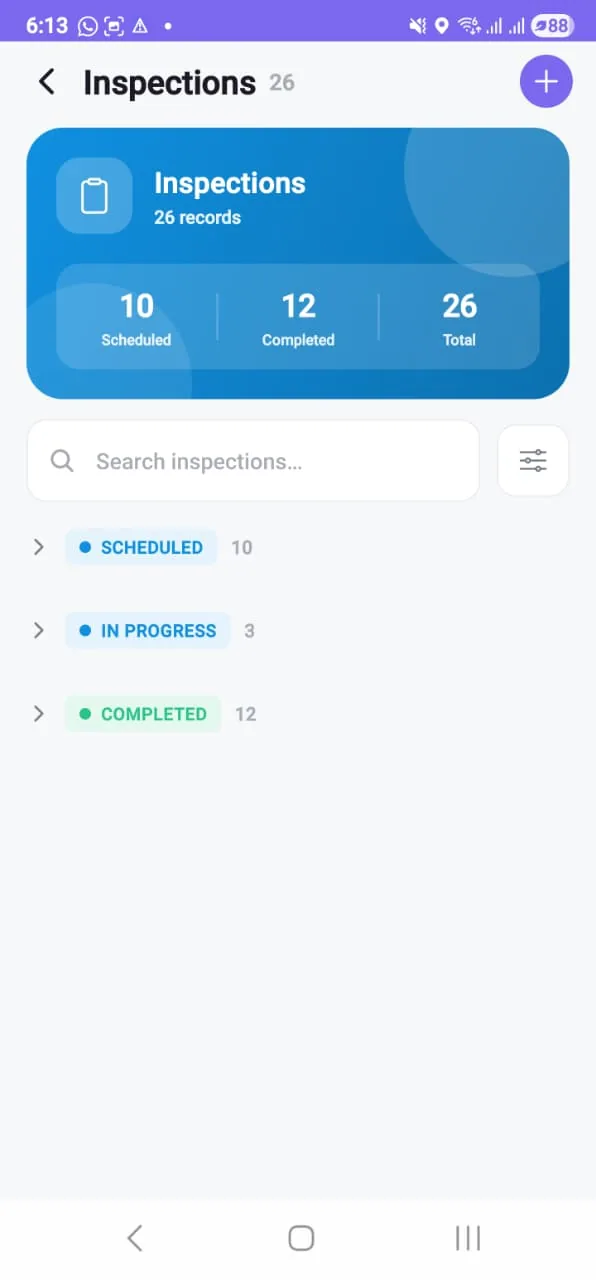
A live programme from a working month, filterable by stage, area and inspector — and searchable across the text of the findings, not just the round titles.
Inspection programme
One working month — every round with an area, a date and a named inspector
- Shown
- 17
- Completed
- 11
- Findings
- 39
- Critical
- 3
| # | Round | Area | Inspector | Date | Findings | Worst | Stage |
|---|---|---|---|---|---|---|---|
| 4 | Weekly fabrication hall inspection | Gary — Weld Bay 2 | Victor Ramos | 4 | Critical | Completed | |
| 3 | Monthly warehouse safety walk | Houston — Warehouse A | Robert Pierce | 4 | High | Completed | |
| 5 | Chemical yard and bunded storage | Houston — Chemical Yard | Emily Carver | 4 | High | Completed | |
| 7 | Dock and yard traffic inspection | Houston — Loading Dock 3 | Robert Pierce | 3 | Critical | Completed | |
| 6 | Tank farm integrity and access | Baton Rouge — Tank Farm B | Derek Coleman | 3 | High | Completed | |
| 9 | Maintenance shop and tool crib | Houston — Maintenance Shop | James Okonkwo | 4 | High | Completed | |
| 11 | Production floor monthly inspection | Ridgeline Houston Plant | Tanya Brooks | 4 | Critical | Completed | |
| 10 | Paint booth and finishing area | Gary — Paint Booth | Victor Ramos | 3 | High | Completed | |
| 12 | Drum storage and waste area | Baton Rouge — Drum Storage | Emily Carver | 3 | High | Completed | |
| 8 | Distribution centre monthly walk | Phoenix — Dock Apron | Robert Pierce | 2 | Medium | Completed | |
| 14 | Paint booth LEV and fire protection inspection | Gary — Paint Booth | Victor Ramos | 2 | Medium | Completed | |
| 16 | LEV survey — solvent decanting bench | Houston — Chemical Yard | Priya Natarajan | 1 | High | In progress | |
| 15 | Office and common areas quarterly | Ridgeline Corporate Office | Karen Liu | 1 | Low | In progress | |
| 17 | Confined space equipment verification | Baton Rouge — Tank Farm B | Derek Coleman | 1 | High | In progress | |
| 19 | Weekly fabrication hall inspection | Gary — Weld Bay 2 | Victor Ramos | — | — | Scheduled | |
| 18 | Monthly warehouse safety walk | Houston — Warehouse A | Robert Pierce | — | — | Scheduled | |
| 20 | Maintenance shop and tool crib | Houston — Maintenance Shop | James Okonkwo | — | — | Scheduled |
- 4CriticalCompleted
Weekly fabrication hall inspection
- Area
- Gary — Weld Bay 2
- Inspector
- Victor Ramos
- Date
- Findings
- 4
- 3HighCompleted
Monthly warehouse safety walk
- Area
- Houston — Warehouse A
- Inspector
- Robert Pierce
- Date
- Findings
- 4
- 5HighCompleted
Chemical yard and bunded storage
- Area
- Houston — Chemical Yard
- Inspector
- Emily Carver
- Date
- Findings
- 4
- 7CriticalCompleted
Dock and yard traffic inspection
- Area
- Houston — Loading Dock 3
- Inspector
- Robert Pierce
- Date
- Findings
- 3
- 6HighCompleted
Tank farm integrity and access
- Area
- Baton Rouge — Tank Farm B
- Inspector
- Derek Coleman
- Date
- Findings
- 3
- 9HighCompleted
Maintenance shop and tool crib
- Area
- Houston — Maintenance Shop
- Inspector
- James Okonkwo
- Date
- Findings
- 4
- 11CriticalCompleted
Production floor monthly inspection
- Area
- Ridgeline Houston Plant
- Inspector
- Tanya Brooks
- Date
- Findings
- 4
- 10HighCompleted
Paint booth and finishing area
- Area
- Gary — Paint Booth
- Inspector
- Victor Ramos
- Date
- Findings
- 3
- 12HighCompleted
Drum storage and waste area
- Area
- Baton Rouge — Drum Storage
- Inspector
- Emily Carver
- Date
- Findings
- 3
- 8MediumCompleted
Distribution centre monthly walk
- Area
- Phoenix — Dock Apron
- Inspector
- Robert Pierce
- Date
- Findings
- 2
- 14MediumCompleted
Paint booth LEV and fire protection inspection
- Area
- Gary — Paint Booth
- Inspector
- Victor Ramos
- Date
- Findings
- 2
- 16HighIn progress
LEV survey — solvent decanting bench
- Area
- Houston — Chemical Yard
- Inspector
- Priya Natarajan
- Date
- Findings
- 1
- 15LowIn progress
Office and common areas quarterly
- Area
- Ridgeline Corporate Office
- Inspector
- Karen Liu
- Date
- Findings
- 1
- 17HighIn progress
Confined space equipment verification
- Area
- Baton Rouge — Tank Farm B
- Inspector
- Derek Coleman
- Date
- Findings
- 1
- 19—Scheduled
Weekly fabrication hall inspection
- Area
- Gary — Weld Bay 2
- Inspector
- Victor Ramos
- Date
- Findings
- —
- 18—Scheduled
Monthly warehouse safety walk
- Area
- Houston — Warehouse A
- Inspector
- Robert Pierce
- Date
- Findings
- —
- 20—Scheduled
Maintenance shop and tool crib
- Area
- Houston — Maintenance Shop
- Inspector
- James Okonkwo
- Date
- Findings
- —
Seventeen of 26 rounds in the month — 13 completed, three under way and 10 already on the schedule. 41 findings came off the completed ones, every one of them graded and on file. A round that has not been walked shows a dash rather than a zero.
Export the filtered setThe same programme, in the hand
Grouped by stage, so a supervisor opens the app and sees what they are walking today. The whole round happens here: open it at the area, add findings one at a time, complete it standing where you finished.
Search runs across the findings as well as the titles. Searching “racking” finds the walk that recorded the damaged upright, which is the only way twelve months of rounds are worth keeping.
41 findings in a month, every one graded
An inspection programme is judged on its findings, not its completion rate. One of those numbers is about condition; the other is about attendance.
- Critical37%
- High1537%
- Medium1946%
- Low410%
3.2
Findings per completed round. This is the number worth watching, and the one a completion percentage hides. An area that drops toward zero has either been fixed or stopped being looked at.
41
Thirteen rounds, 41 graded findings. Not a completion rate. A programme is judged on what it found, and on whether those findings went anywhere.
A hundred percent completed with nothing found is a programme telling you it has stopped looking. Thirteen rounds producing 41 graded findings — three of them critical — is one that is working. The low ones matter too: on their own they are a nuisance, and across six months they are a pattern.
Four findings, one of them critical
None of these is exotic. All four are the kind of thing that is visible to anybody who looks, and invisible to anybody who doesn't.
Weekly fabrication hall inspection
Gary — Weld Bay 2 · Aug 06 · Victor Ramos · one hour
- 01Critical
Junction box beside bay 2 missing its cover plate — conductors exposed at chest height.
- 02High
Oxy/fuel cylinders standing unsecured against the bay 3 wall, with no separation between them.
- 03Medium
Welding screens between bays 1 and 2 burnt through at eye level.
- 04Medium
Extraction at bay 1 measured well below its design flow.
The box was isolated before the inspector left the bay. That is the interim control, not the fix — the fix is a corrective action with a name and a date on it.
Follow action 22 into the trackerA finding that stays in the inspection is just a nicer notebook
The round records what was seen. The corrective action carries what was done about it — and it lives in the same queue as everything else, because a second overdue list is a list nobody reads.
One queue, one overdue count
Findings raise actions into the same tracker as incidents, near misses, hazards and failed equipment checks. Not an inspection to-do list living beside a CAPA to-do list.
An owner and a date, chased
Assigned to a person, not a team inbox, with a due date agreed when it is raised and automatic chasing when it runs late.
Managers know the same day
Notified when a round is scheduled and again when it completes, so the findings land while the walk is still fresh rather than in a monthly pack.
Findings do not close because the inspection closed. The round completes; the action stays open until somebody does the work and it is reviewed. See what happens to it next in corrective actions.
From booked to retained
Nine steps, and the first of them happens before anybody walks anywhere.
- 1
Scheduled
Area, date and a named inspector. The record exists before the walk does, which is what makes a missed round visible instead of silent.
- 2
Assigned
The inspector is notified, and it lands on their planboard lane without a planner touching it.
- 3
Walked
Opened on the phone at the area, not reconstructed at a desk afterwards. Captured where there is signal and synced when there is.
- 4
Findings recorded
One line each, graded low to critical as they are seen. The composer is inline — no second screen, no form to come back to.
- 5
Photographed
Evidence attaches to the round. A photograph of a missing cover plate is a record; “electrical issue in bay 2” is a recollection.
- 6
Completed
Managers are notified the same day, so the findings land while the walk is still fresh rather than at the end of the month.
- 7
Actioned
Each finding becomes a corrective action with an owner, a date and automatic chasing. Findings do not close because the inspection closed.
- 8
Searchable
Across the text of the findings, not just the round’s title — searching “racking” finds the walk that recorded the damaged upright.
- 9
Retained
Every field change attributed, the filtered set exportable, the whole programme retrievable at audit without rebuilding it.
An hour a week per area is real money. Ask what it bought.
Three numbers a Plant Director can read off this programme, none of which a completion percentage will give them.
3.2
Findings per round
Per area and per inspector, filter-aware. An area trending toward zero has either been fixed or stopped being looked at — and this is the number that makes you ask which.
Four grades, word and colour
The severity word stays on the pill everywhere it appears. Grading by colour alone fails for a lot of readers on a four-step scale, and a grade nobody can read is a grade nobody acts on.
Stage is deliberately colourless. The schedule is furniture; the severity beside it is the news.
Live, and counted on the server
The board updates when a colleague completes a round. Counts follow the filter and are computed server-side, so they stay right at any volume rather than tallying whatever one page happened to load.
Fields can be renamed, hidden, defaulted or required; every change is attributed in the audit trail.
What an auditor actually asks for
Not “do you inspect”, but “show me the programme, the findings, and what happened to them”.
| Requirement | What it asks for | Where the evidence comes from |
|---|---|---|
| ISO 45001:20189.1 | Monitoring, measurement & analysis | A scheduled programme with graded results, per area, rather than a folder of signed forms |
| ISO 45001:20186.1.2 | Hazard identification & risk assessment | Findings feed the hazard register and the corrective-action tracker on the day they are recorded |
| ISO 45001:201810.2 | Incident, nonconformity & corrective action | Finding → owned action → verified closure, in the same queue as incidents and near misses |
| ISO 45001:20188.1.2 | Hierarchy of controls | What the resulting action actually changed, recorded against the hierarchy of controls |
| ISO 45001:20187.4 | Communication | The inspector notified on assignment; managers notified the day a round completes |
| ISO 45001:20187.5 | Documented information | Every round and every finding retained, attributed and retrievable |
| OSHA 29 CFR1910 Subpart A–J | General duty and workplace conditions | Documented periodic inspection of areas and equipment, with the finding and its abatement on the same chain |
ISO 45001:20189.1
Monitoring, measurement & analysis
Where the evidence comes from
A scheduled programme with graded results, per area, rather than a folder of signed forms
ISO 45001:20186.1.2
Hazard identification & risk assessment
Where the evidence comes from
Findings feed the hazard register and the corrective-action tracker on the day they are recorded
ISO 45001:201810.2
Incident, nonconformity & corrective action
Where the evidence comes from
Finding → owned action → verified closure, in the same queue as incidents and near misses
ISO 45001:20188.1.2
Hierarchy of controls
Where the evidence comes from
What the resulting action actually changed, recorded against the hierarchy of controls
ISO 45001:20187.4
Communication
Where the evidence comes from
The inspector notified on assignment; managers notified the day a round completes
ISO 45001:20187.5
Documented information
Where the evidence comes from
Every round and every finding retained, attributed and retrievable
OSHA 29 CFR1910 Subpart A–J
General duty and workplace conditions
Where the evidence comes from
Documented periodic inspection of areas and equipment, with the finding and its abatement on the same chain
SentinelHSE supports evidencing these requirements. Certification is an audit of your organisation, not of software — any vendor who tells you their product makes you compliant is selling you a problem.
The seven things you are already thinking
Including the one that sounds like good news until you look at it.
Then answer this without leaving your desk: what did the last four warehouse rounds find, and which of those findings are still open? Paper holds the walk perfectly well. What it cannot do is let you ask a question of twelve months of walks, or make a finding somebody else’s dated job before the inspector gets back.
Then the interesting number is findings per round, not completion. A programme at a hundred percent finding nothing is measuring attendance. In the illustrative month on this page that number is 3.2 — and if one of your areas is trending toward zero, either it has genuinely been fixed or it has stopped being looked at, and the record alone cannot tell you which.
For a general safety round, no — the inspector records what they find and grades it low to critical. A fixed checklist trains people to look only at the list, and the thing that hurts somebody is usually not on it. Equipment inspections are the checklist-driven ones, with their own step-by-step forms: 10 points for an extinguisher, 15 for a first-aid box. Two different jobs, two different tools.
The round is captured at the area and syncs when there is signal. That matters more than it sounds — the moment a walk has to be written up somewhere with coverage, it gets written up from memory, and a finding written from memory is a finding that lost its detail.
Whoever the corrective action names. Findings do not close because the inspection closed — they go into the same tracker as incidents, near misses and failed equipment checks, each with an owner, a date and automatic chasing. The round records what was seen; the action carries what was done about it.
No. People inspect. The platform schedules the round so it exists before it happens, puts a name and an area on it, captures each observation where it is seen, grades it, and makes sure every finding becomes owned work. That is a smaller claim than most vendors make and it is the one that survives a plant.
Yes, including on your own infrastructure. Permissions are granular — view, create, update and delete — and every field change is attributed in the audit trail.
The platform does not inspect. People inspect. It schedules the round so it exists before it happens, holds the 17 shown here with an area, a date and a named inspector on every one, captures each observation where it is seen, and makes sure the findings become owned work.
See it on your own data
Send us last quarter's inspection forms — scans are fine. We'll load them, grade the findings, and show you which areas are producing findings and which have gone quiet.
45 minutes. The quiet areas are usually the interesting part of that conversation.