The injury you prevent never appears in your numbers.
Near misses are the only safety data you get before someone is hurt. SentinelHSE removes the friction that stops people reporting them — then turns what they report into owned, dated, evidenced action.
A low near-miss count is not safety. It is silence.
When a site reports two near misses a quarter, nobody concludes the site is safe. They conclude nobody is writing them down.
That is the whole problem. Every serious injury was preceded by conditions somebody saw. The question is not whether your people notice. It is whether telling you costs them anything.
Reporting has to cost less than staying quiet
Four facts about the form, not four promises. A programme dies where filing a report is more effort than walking past.
The whole form, every field of it, and the record it becomes.
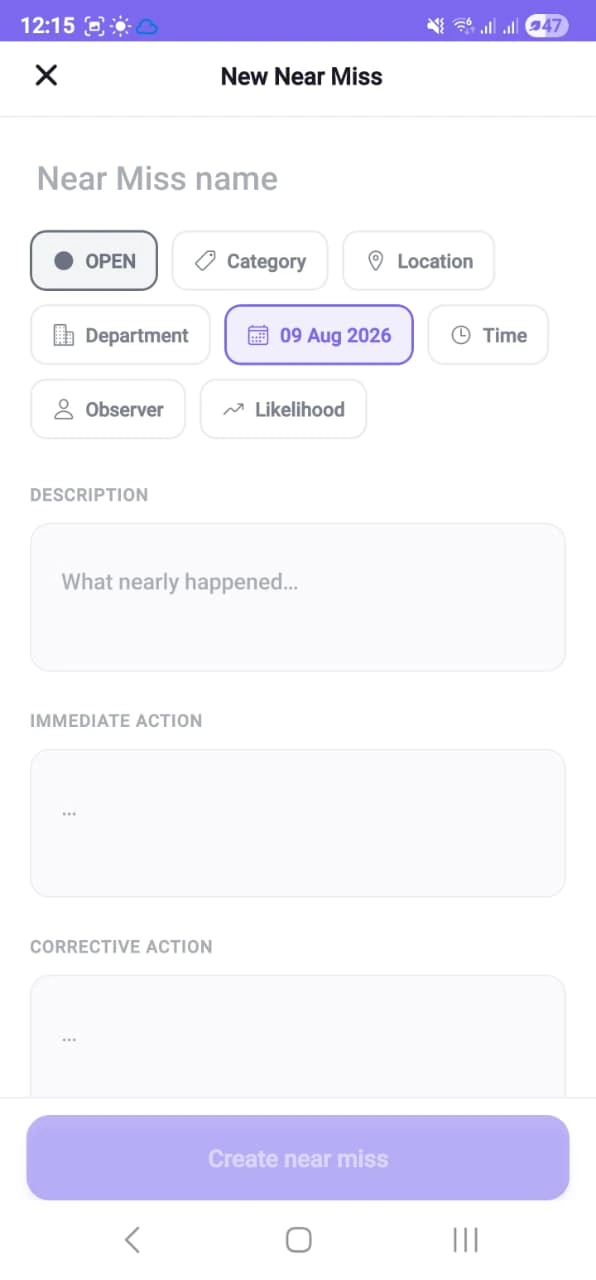
Filing it, in under a minute
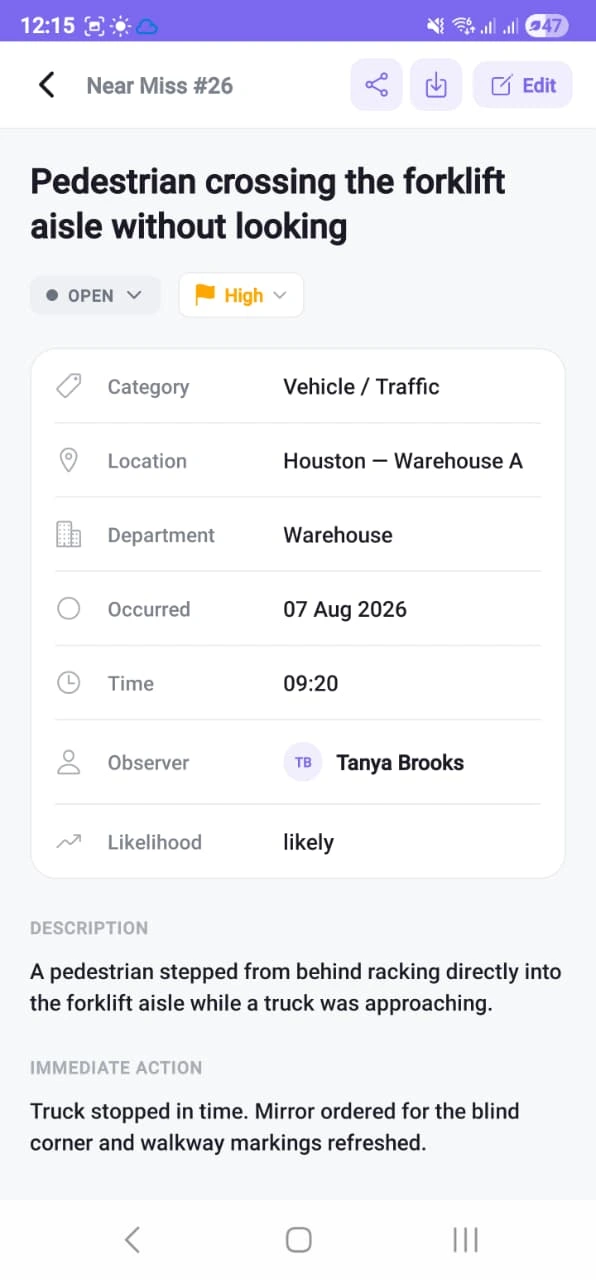
What it becomes
Screenshots from a working build. Illustrative records.
Under a minute, one hand
Photo, category, what could have happened. On a cheap Android, on a weak signal, without going to find a laptop.
No blame surface
The form captures the condition, not a culprit. There is no field for whose fault it was, because that field is what empties a register.
The exact area, not the site
Locations resolve to Warehouse A, Aisle 4 rather than “Houston Plant”. A pattern you cannot locate is a pattern you cannot fix.
The reporter sees it close
They are told what happened to their report. Nothing kills a programme faster than reports disappearing into a void.
The base is where you still have a choice
One site, one month. The tiers are not a fixed ratio, and what matters is which one you can still learn from.
- 4Recordable injuriesHarm already done
- 14IncidentsSomething happened
- 48Near missesThe outcome was still open
- —Observations & hazardsA condition somebody noticed
Illustrative figures from the product demo. Near-miss to incident ratio 3.4 : 1. Every tier below the top is an event where the outcome was still open. A programme that only records the top tier is a programme that only learns from harm.
Observations sit at the base without a count on purpose. The ratios between these tiers are a property of one site in one month — not a law of nature.
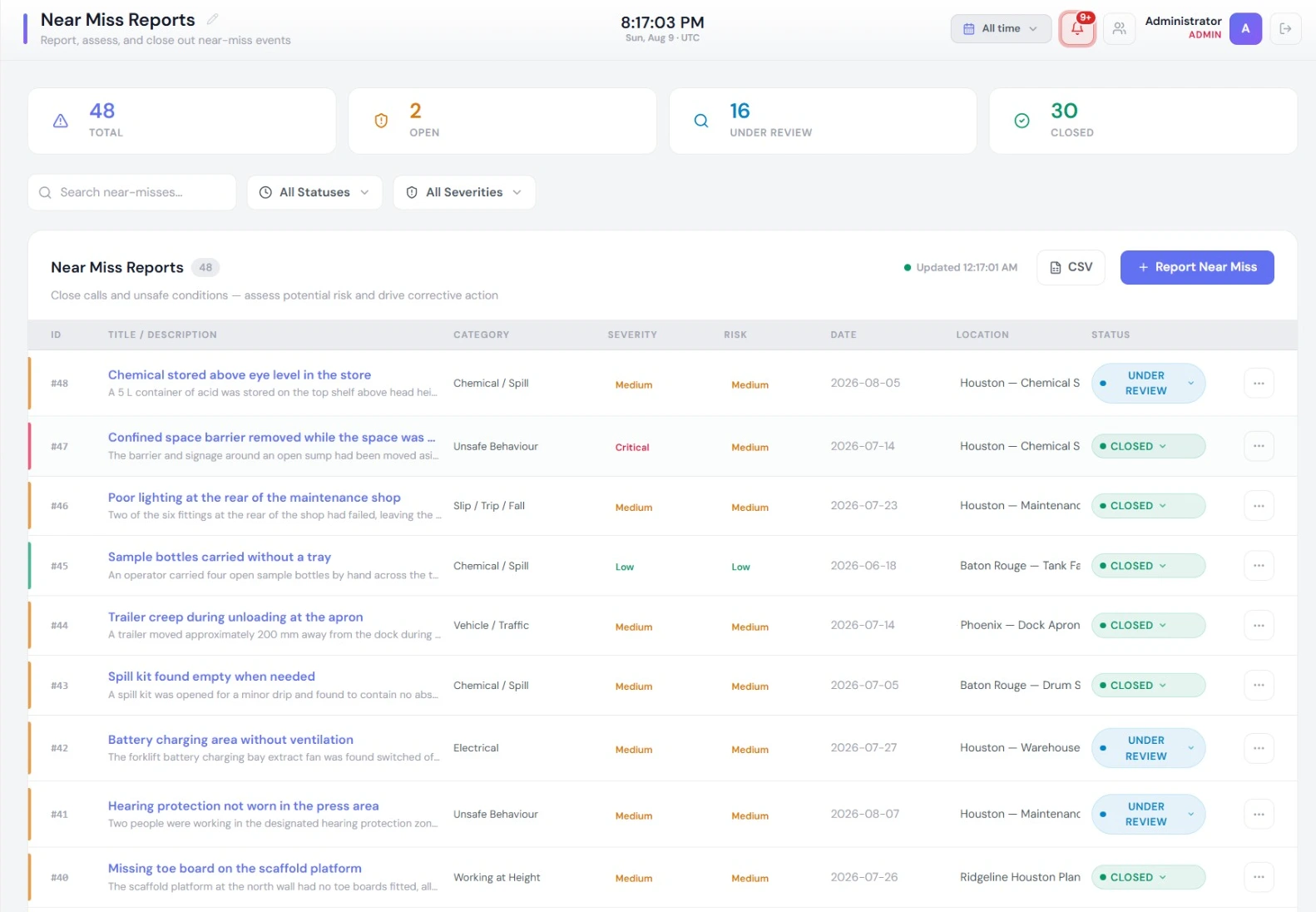
One register. Every report. Ranked by what could have happened.
A live register from a working month, filterable by potential severity, status, site and category.
Near-miss register
One working month across four sites, ranked by what could have happened
| ID | Date | What was reported | Category | Site | Potential | Likelihood | Reported by | Status |
|---|---|---|---|---|---|---|---|---|
| NM-7 | Jul 25 | Employee reaching into a conveyor to clear a jam | Unsafe Behaviour | Houston — Warehouse A | Critical | Possible | Robert Pierce | Closed |
| NM-28 | Jul 11 | Guard interlock defeated with a cable tie | Machinery / Equipment | Gary — Weld Bay 2 | Critical | Possible | Victor Ramos | Closed |
| NM-17 | Jul 25 | Working at height with an unclipped harness | Working at Height | Baton Rouge — Tank Farm B | Critical | Possible | Derek Coleman | Under review |
| NM-23 | Aug 04 | Spark from an angle grinder near the solvent store | Fire / Explosion | Houston — Chemical Yard | Critical | Unlikely | Angela Reyes | Open |
| NM-47 | Jul 14 | Confined space barrier removed while the space was open | Unsafe Behaviour | Houston — Chemical Yard | Critical | Unlikely | Angela Reyes | Closed |
| NM-6 | Jul 28 | Missing guard on the bench grinder | Machinery / Equipment | Houston — Maintenance Shop | High | Likely | Anthony Russo | Closed |
| NM-26 | Aug 07 | Pedestrian crossing the forklift aisle without looking | Vehicle / Traffic | Houston — Warehouse A | High | Likely | Tanya Brooks | Open |
| NM-5 | Jul 31 | Gas cylinder stored unsecured against the wall | Fire / Explosion | Gary — Weld Bay 2 | High | Possible | Victor Ramos | Closed |
| NM-10 | Jul 23 | Eye wash station blocked by stacked cartons | Chemical / Spill | Houston — Chemical Yard | High | Possible | Angela Reyes | Closed |
| NM-18 | Jul 26 | Damaged flexible hose on the caustic transfer line | Chemical / Spill | Baton Rouge — Drum Storage | High | Possible | Derek Coleman | Under review |
| NM-43 | Jul 05 | Spill kit found empty when needed | Chemical / Spill | Baton Rouge — Drum Storage | Medium | Likely | Emily Carver | Closed |
| NM-19 | Jul 01 | Housekeeping — offcuts left in the walkway | Slip / Trip / Fall | Gary — Weld Bay 2 | Low | Likely | Victor Ramos | Closed |
- NM-7CriticalClosed
Employee reaching into a conveyor to clear a jam
- Date
- Jul 25
- Category
- Unsafe Behaviour
- Site
- Houston — Warehouse A
- Likelihood
- Possible
- Reported by
- Robert Pierce
- NM-28CriticalClosed
Guard interlock defeated with a cable tie
- Date
- Jul 11
- Category
- Machinery / Equipment
- Site
- Gary — Weld Bay 2
- Likelihood
- Possible
- Reported by
- Victor Ramos
- NM-17CriticalUnder review
Working at height with an unclipped harness
- Date
- Jul 25
- Category
- Working at Height
- Site
- Baton Rouge — Tank Farm B
- Likelihood
- Possible
- Reported by
- Derek Coleman
- NM-23CriticalOpen
Spark from an angle grinder near the solvent store
- Date
- Aug 04
- Category
- Fire / Explosion
- Site
- Houston — Chemical Yard
- Likelihood
- Unlikely
- Reported by
- Angela Reyes
- NM-47CriticalClosed
Confined space barrier removed while the space was open
- Date
- Jul 14
- Category
- Unsafe Behaviour
- Site
- Houston — Chemical Yard
- Likelihood
- Unlikely
- Reported by
- Angela Reyes
- NM-6HighClosed
Missing guard on the bench grinder
- Date
- Jul 28
- Category
- Machinery / Equipment
- Site
- Houston — Maintenance Shop
- Likelihood
- Likely
- Reported by
- Anthony Russo
- NM-26HighOpen
Pedestrian crossing the forklift aisle without looking
- Date
- Aug 07
- Category
- Vehicle / Traffic
- Site
- Houston — Warehouse A
- Likelihood
- Likely
- Reported by
- Tanya Brooks
- NM-5HighClosed
Gas cylinder stored unsecured against the wall
- Date
- Jul 31
- Category
- Fire / Explosion
- Site
- Gary — Weld Bay 2
- Likelihood
- Possible
- Reported by
- Victor Ramos
- NM-10HighClosed
Eye wash station blocked by stacked cartons
- Date
- Jul 23
- Category
- Chemical / Spill
- Site
- Houston — Chemical Yard
- Likelihood
- Possible
- Reported by
- Angela Reyes
- NM-18HighUnder review
Damaged flexible hose on the caustic transfer line
- Date
- Jul 26
- Category
- Chemical / Spill
- Site
- Baton Rouge — Drum Storage
- Likelihood
- Possible
- Reported by
- Derek Coleman
- NM-43MediumClosed
Spill kit found empty when needed
- Date
- Jul 05
- Category
- Chemical / Spill
- Site
- Baton Rouge — Drum Storage
- Likelihood
- Likely
- Reported by
- Emily Carver
- NM-19LowClosed
Housekeeping — offcuts left in the walkway
- Date
- Jul 01
- Category
- Slip / Trip / Fall
- Site
- Gary — Weld Bay 2
- Likelihood
- Likely
- Reported by
- Victor Ramos
Showing 12 of 12 rows — twelve of 48 reports in the period. Nobody was hurt in any of them. Five had a credible worst outcome of a fatality.
Rank by what could have happened, not what did
Every report gets a potential severity and a likelihood. The score decides whose week it belongs in.
All 48 reports, by what could have happened
Potential severity down, likelihood across. Shading is severity × likelihood.
| Potential | Rare | Unlikely | Possible | Likely | Almost certain |
|---|---|---|---|---|---|
| Critical | 0score 5 | 2score 10 | 3score 15 | 0score 20 | 0score 25 |
| High | 0score 4 | 0score 8 | 7score 12 | 2score 16 | 0score 20 |
| Medium | 0score 3 | 3score 6 | 15score 9 | 11score 12 | 0score 15 |
| Low | 0score 2 | 0score 4 | 3score 6 | 2score 8 | 0score 10 |
A near miss and a fatality can be the same event with a different ending. Ranking by potential puts the critical reports in front of the plant director this week, not after the event that proves the point.
Severity × likelihood
Each report carries both. The product multiplies them and prints the result on the record — Medium × Possible gives a score of 6. Nothing about the ranking is a matter of opinion once the two fields are set.
The scale is yours
Four severities by five likelihoods here. If your matrix is 5×5, or your labels differ, that is configuration an administrator changes — and the scores recalculate against your model, not ours.
The score sets the queue
A manager works down from the top-right corner. The five critical reports get looked at this week, rather than after the event that proves they mattered.
The number to watch is how many people report
Lagging indicators count the harm you already did. Leading indicators are the ones you can still act on.
Lagging
harm already done
- TRIRTotal Recordable Incident Rate
- recordable cases × 200,000 / hours worked
- LTIFRLost Time Injury Frequency Rate
- lost-time injuries × 1,000,000 / hours worked
Never quote either without its multiplier. Conventions differ, and a rate without one is not a rate.
Leading
harm not yet done
- Near-miss reporting rate
- Reports per person per period. The number that moves first when the friction goes.
- Participation
- How many people filed at least one. One enthusiast filing forty is not a programme.
- High-potential reports
- Ranked by what could have happened. These are the ones worth a manager’s week.
- Actions closed on time
- The percentage that did not run late — and the reason people keep reporting.
Illustrative — figures from the product demo
67%
participation — 10 of 15 staff filed at least one report
48
reports in the period
63%
already closed out
A rising near-miss count is a programme working, not a site getting worse — and the board needs to be told that before the first spike, not during it.
A report nobody acts on trains people to stop reporting
The second report is filed on the strength of what happened to the first one.
- 01
Reported
From the floor, on a phone, in under a minute.
- 02
Ranked by potential
Severity × likelihood gives a score, and the score sets the queue.
- 03
Immediate action recorded
What was done on the spot, captured while it is still true.
- 04
Corrective action raised
An owner and a due date, against the hierarchy of controls.
- 05
Chased automatically
Overdue actions escalate on their own. Nobody has to remember.
- 06
Closed and verified
Verified effective before the record closes.
- 07
Briefed at the toolbox talk
And the reporter is told what happened to their report.
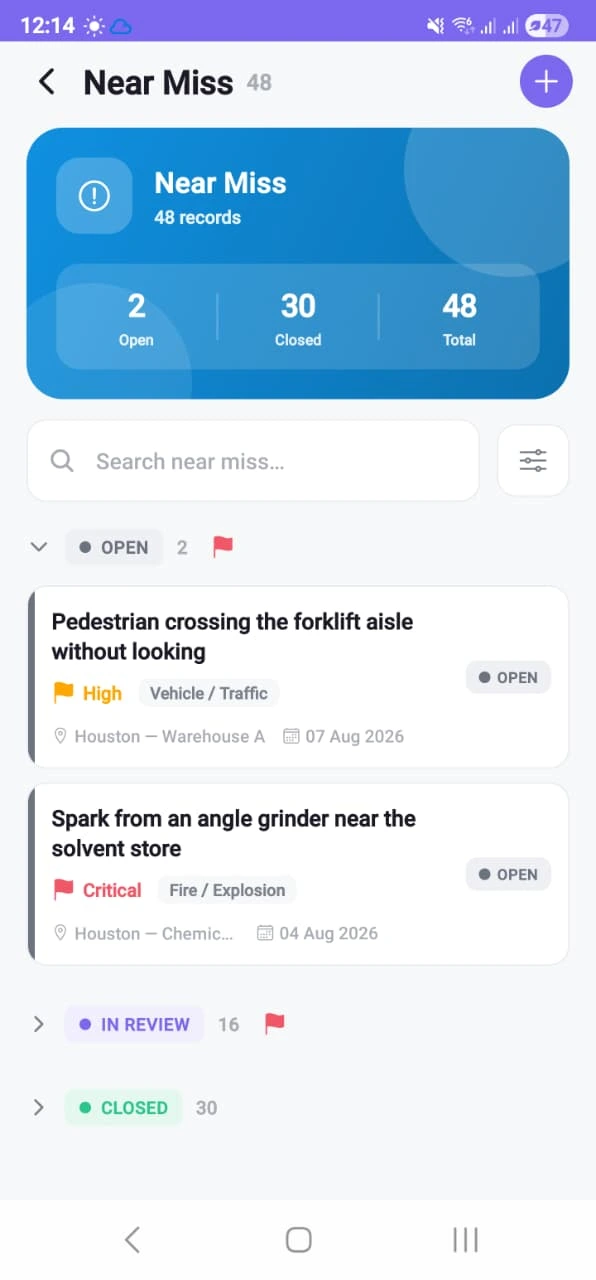
Grouped by state, so the two still open are the first thing anyone sees — including the person who filed them.
What an auditor actually asks for
Buyers respond to clause numbers rather than feature lists, because the clause is the artefact they have to produce.
| Requirement | What it asks for | Where the evidence comes from |
|---|---|---|
| ISO 45001:20186.1.2 | Hazard identification & risk assessment | Near-miss and hazard reporting, ranked by potential severity × likelihood |
| ISO 45001:20185.4 | Consultation & participation of workers | Reporting from the field by anyone on site, and feedback to the reporter |
| ISO 45001:20189.1 | Monitoring, measurement & analysis | Leading indicators, participation, and trend by site and category |
| ISO 45001:201810.2 | Incident, nonconformity & corrective action | Corrective actions with owners, dates and verified closure |
| ISO 45001:20187.4 | Communication | What was learned, briefed at the next toolbox talk |
ISO 45001:20186.1.2
Hazard identification & risk assessment
Where the evidence comes from
Near-miss and hazard reporting, ranked by potential severity × likelihood
ISO 45001:20185.4
Consultation & participation of workers
Where the evidence comes from
Reporting from the field by anyone on site, and feedback to the reporter
ISO 45001:20189.1
Monitoring, measurement & analysis
Where the evidence comes from
Leading indicators, participation, and trend by site and category
ISO 45001:201810.2
Incident, nonconformity & corrective action
Where the evidence comes from
Corrective actions with owners, dates and verified closure
ISO 45001:20187.4
Communication
Where the evidence comes from
What was learned, briefed at the next toolbox talk
SentinelHSE supports evidencing these requirements. Certification is an audit of your organisation, not of software — any vendor who tells you their product makes you compliant is selling you a problem.
The five things you are already thinking
Answered the way we would answer them in the room, including where the risk is real.
Yes, and that is the point. A rising near-miss count is a functioning programme, not a deteriorating site — but only if everyone has agreed that in advance. Settle with your board which direction is good before the first month’s spike, or the spike will be used against you and the programme will not survive it.
The form captures the condition, not a culprit — there is no field for who was at fault. That helps, and it is not sufficient. If a near-miss programme is used for blame it will die within a month whatever software you buy, so the first thing to fix is what happens to the second person who reports something awkward.
Often true, and usually the app’s fault. Adoption is the design constraint here: under a minute, one hand, a cheap Android, a weak signal. The honest test is not a demo — run one crew for a month and measure the reporting rate before and after. If it does not move, it has not worked, and you should not roll it out.
Yes. It can run in our cloud, inside your own cloud account under your policies and retention rules, or entirely on your own servers for sites that cannot send safety data outside at all. Everything exports, so leaving stays a decision you can make later.
Yes. Categories, potential-severity levels, likelihood scales and form fields are configuration, changed by an administrator without development work. If your matrix is 5×5 rather than 4×5, the platform should learn your model rather than the other way round.
See it on your own data
Bring a month of your near misses — even if there are only three. We'll load them and show you the register, the risk matrix and the participation rate your board would see.
45 minutes. Or run a four-week pilot with one crew and measure the reporting rate yourself.